RPM Medical: How Remote Patient Monitoring Works in Healthcare
Many chronic conditions don’t announce themselves during a 15-minute office visit. Blood pressure spikes at 2 a.m. Glucose drifts upward for three weeks before a lab catches it. Fluid builds in a heart failure patient’s lungs days before shortness of breath brings them to the emergency room. By the time a patient sits down in an exam chair, the moment where clinical intervention would have mattered most has already passed.
RPM medical services, structured, physician-supervised programs using connected devices to collect and transmit physiologic data from a patient’s home, exist to close that gap. Clinical RPM programs typically use FDA-cleared devices to generate a continuous stream of health data between scheduled visits, feeding clinical decision-making in real time rather than waiting for the next appointment. At RemoteHCS, we operate exactly this kind of program: licensed clinicians monitoring patients across multiple states, with a specific focus on chronic conditions like diabetes, hypertension, heart failure, COPD, and kidney disease. (Service availability varies by state due to licensing requirements.)
This article breaks down what remote physiologic monitoring involves clinically, which conditions and specialties it serves, how care teams use it in real practice, and what CMS pays for it. Whether you’re a clinician evaluating whether to add RPM to your practice or a patient trying to understand your options, here’s what you need to know.
What RPM medical means in a clinical context
Most people hear “telehealth” and think video calls. Remote patient monitoring is different in a fundamental way: it’s a continuous, data-driven monitoring model that operates between visits, not during them. This is also where telemonitoring fits, a term sometimes used interchangeably with RPM to describe ongoing, technology-enabled physiologic surveillance outside of a traditional care setting. The formal CMS term is remote physiologic monitoring, which refers specifically to the collection, transmission, and clinical review of physiologic data generated by a patient outside of a traditional care setting. That distinction matters because it defines the entire clinical workflow.
RPM is not a consumer wellness app or a fitness tracker subscription. It’s a regulated medical service that requires a physician order, an established patient relationship, and a qualifying acute or chronic condition. Clinical RPM programs typically use FDA-cleared devices to ensure accuracy and regulatory accountability, a standard that separates them from the broader digital health landscape and places them squarely within clinical medicine.
How RPM differs from general telehealth
A telehealth video visit replaces an in-person appointment. Remote patient monitoring does something different: it creates a continuous data stream that feeds clinical decision-making in real time, regardless of whether the patient has a scheduled appointment. A cardiologist conducting a video visit is still working from a snapshot. A care team reviewing daily blood pressure and weight data from a heart failure patient is working from a trend. Those are fundamentally different clinical tools.
The clinical workflow: from physician order to daily data review
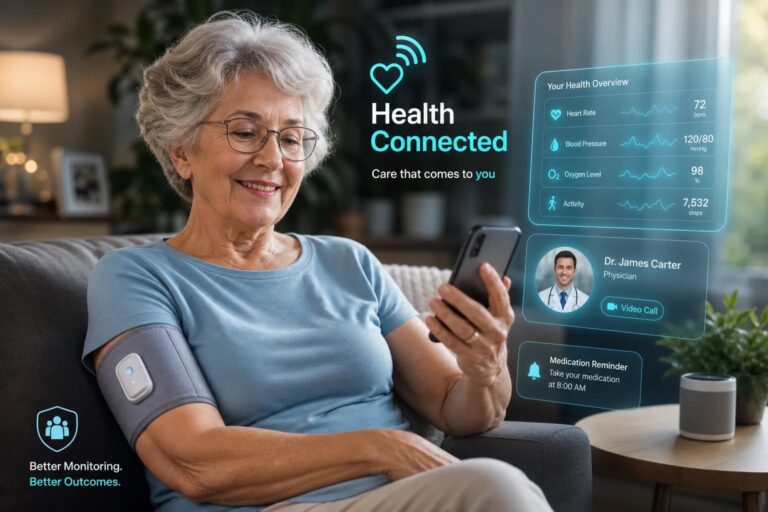
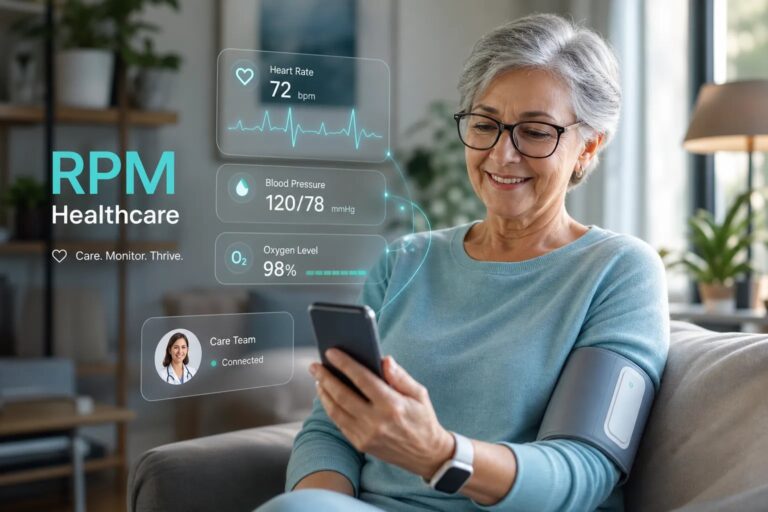
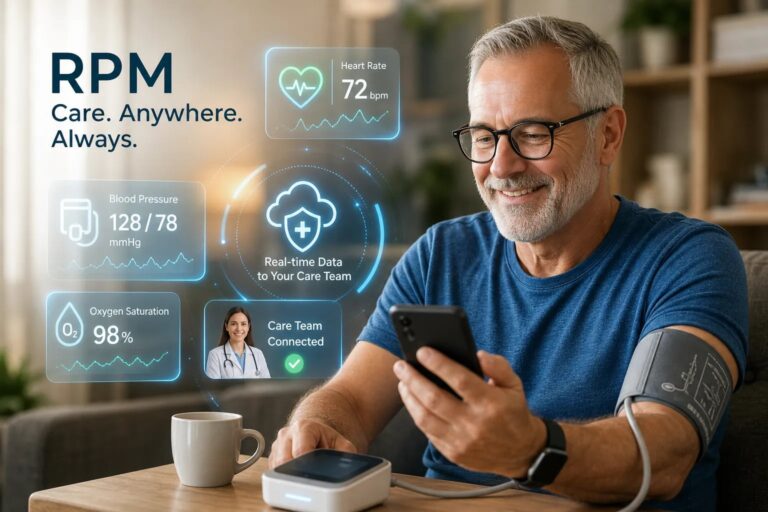
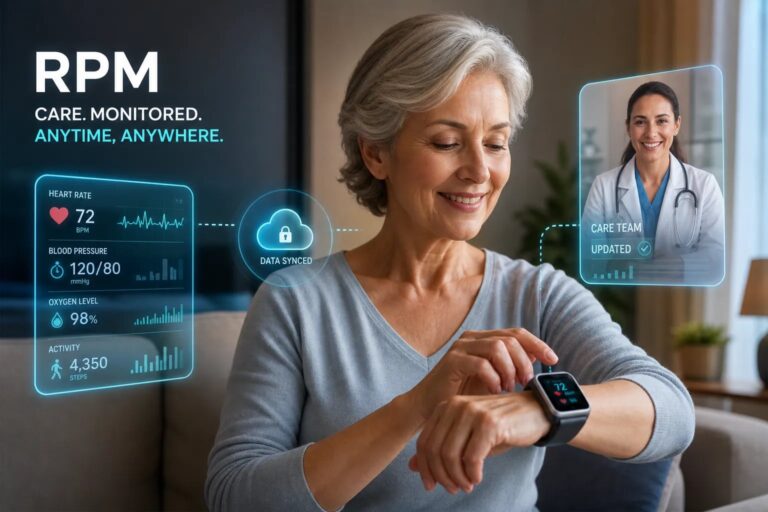
The clinical workflow follows a predictable structure. A provider orders RPM for a qualifying patient, the patient receives a device kit configured for their specific condition, and the devices transmit readings automatically over cellular or Bluetooth to an RPM software platform. A care team reviews that data daily, acts on significant changes, and communicates with the patient or their ordering provider when the data warrants it. The patient doesn’t need to do anything beyond using their device; the transmission happens in the background.
What “medically reasonable and necessary” means for RPM eligibility
CMS requires that RPM be medically reasonable and necessary, which means the monitoring must directly inform clinical management of a documented condition. A patient with controlled hypertension who sees their doctor twice a year and has stable readings may not qualify. A patient with poorly controlled hypertension, recent medication adjustments, or comorbid kidney disease almost certainly does. The ordering provider documents the medical necessity, and that documentation anchors every claim that follows.
Medical conditions that RPM programs are built to manage
Remote physiologic monitoring isn’t a one-size solution. The entire clinical model is built around specific conditions where daily physiologic data directly changes what a clinician does next. When the data doesn’t change clinical decision-making, monitoring adds cost without benefit. When it does, it changes the trajectory of care.
Hypertension is the highest-volume condition in most RPM medical programs. Blood pressure variability between visits is clinically significant, and a reading taken every few weeks in a clinical setting captures almost none of it. Daily home readings give the care team a real picture of blood pressure control, medication response, and white-coat effect, the kind of information that actually guides titration decisions.
Cardiovascular conditions: hypertension and heart failure monitoring
Heart failure monitoring relies heavily on connected weight scales because daily weight change is one of the earliest signals of fluid retention. Small rapid weight gains, often cited in clinical guidelines as 2 to 3 pounds over 24 to 48 hours, can signal fluid retention and impending decompensation. When the care team catches that trend early, they can intervene before the patient ends up in the emergency room. That’s the core clinical value of RPM for heart failure patients: turning a reactive system into a proactive one.
Metabolic and respiratory disease: diabetes and COPD
For diabetes management, RPM programs use glucometers or continuous glucose monitors to capture glucose patterns across the day rather than relying on point-in-time lab draws. That data supports medication titration, identifies nocturnal hypoglycemia, and gives the care team actionable information between quarterly A1c checks. For COPD, pulse oximetry is the primary monitoring tool. In some patients, SpO2 decline can precede an acute exacerbation by days, and catching that decline early gives clinicians a window to adjust therapy before the patient deteriorates significantly.
Kidney disease, post-surgical recovery, and the polychronic patient
Chronic kidney disease monitoring typically combines blood pressure and weight data to track fluid status and cardiovascular risk, both of which are closely linked to disease progression. Post-surgical recovery programs use RPM as a safety net between discharge and follow-up, monitoring vitals during the high-risk window when patients are home but still clinically fragile. The most complex cases involve polychronic patients, those managing two or more chronic conditions simultaneously. RPM becomes especially useful in those cases because it gives the care team a continuous, multi-parameter picture rather than a disconnected series of snapshots from different specialty visits.
Which medical specialties integrate RPM into practice
RPM started in cardiology and expanded steadily from there. The specialty that implements it drives the device selection, the monitoring frequency, and the escalation thresholds the care team sets. A nephrologist monitoring CKD patients sets different alert thresholds than a pulmonologist monitoring post-discharge COPD patients. The clinical context shapes the entire program design.
Primary care physicians and internists are the highest-volume RPM users by a significant margin. Analysis of traditional Medicare billing data shows primary care accounting for roughly 63% of RPM services delivered, with cardiology following at approximately 20% and pulmonology at around 4%. That concentration makes sense: primary care manages the chronic disease burden that drives most RPM volume, and the breadth of conditions they treat makes condition-specific device monitoring a practical tool across a large patient panel.
Primary care and internal medicine: the highest-volume RPM users
For a primary care physician managing a panel of patients with hypertension, diabetes, and heart failure, RPM offers something that periodic office visits can’t: a continuous connection to each patient’s daily health status. Abnormal readings surface automatically, allowing the care team to prioritize who needs a call, a medication adjustment, or an earlier appointment. That kind of triage capability changes how efficiently a practice manages its highest-risk patients.
Cardiology and pulmonology: monitoring hearts and lungs between visits
Cardiologists use RPM for heart failure management, post-cardiac-event follow-up, and blood pressure-driven cardiovascular risk reduction. Pulmonologists rely on pulse oximetry-based monitoring for COPD, post-COVID respiratory recovery, and patients on supplemental oxygen. Both specialties deal with conditions where deterioration can happen quickly and where early detection of physiologic changes is often the difference between an outpatient call and a hospitalization.
Nephrology and endocrinology: condition-specific data at scale
Nephrologists integrate RPM to track fluid status and blood pressure trends in CKD and dialysis patients, two metrics closely tied to disease progression and cardiovascular mortality in that population. Endocrinologists use RPM, particularly CGM-based monitoring, to manage glucose variability in complex diabetes cases where quarterly lab values provide far too little resolution to guide treatment decisions. Both specialties benefit from the same fundamental advantage: more frequent data enabling more precise clinical management.
The devices inside a clinical RPM kit
A standard RPM kit is purpose-built for a specific condition. The hardware matches the monitoring goal: a hypertension patient receives a connected blood pressure cuff, a heart failure patient receives a blood pressure cuff and a weight scale, a COPD patient receives a pulse oximeter, and a diabetes patient receives a glucometer or CGM. Device selection isn’t arbitrary; it follows the clinical question the care team is trying to answer with daily data.
FDA clearance is what separates clinical RPM devices from consumer wellness products. The most common device categories used in medical monitoring programs are cleared as Class II medical devices through the FDA’s 510(k) pathway. That clearance establishes clinical validity, regulatory accountability, and documented performance standards. Connected blood pressure cuffs are typically regulated under 21 CFR 870.1130 with product code DXN. Pulse oximeters, glucometers, and connected weight scales used for medical monitoring follow the same general pathway when marketed for clinical use. Consumer wellness devices that make no medical claims operate in an entirely different regulatory space and don’t carry the same accountability. Note that intended use determines classification, and some consumer devices may be unregulated if no medical claims are made.
FDA clearance and why it matters for clinical RPM programs
When a practice or health system selects devices for an RPM program, FDA clearance isn’t a formality. It’s the clinical foundation of the program’s validity. A care team acting on blood pressure readings from a non-cleared device is making clinical decisions on data without validated accuracy standards. That’s both a liability issue and a patient safety issue. Verifying a device’s 510(k) clearance through the FDA database before including it in an RPM kit is a basic due-diligence step that separates rigorous programs from careless ones.
Blood pressure, glucose, SpO2, and weight: what each device tracks
Each device category generates a specific type of clinically actionable data. Connected blood pressure cuffs track systolic and diastolic readings and pulse rate, typically transmitted after each measurement. Glucometers capture pre- and post-meal glucose values; CGMs generate continuous interstitial glucose data including trend direction. Pulse oximeters measure oxygen saturation and pulse rate, flagging SpO2 drops that may precede exacerbations. Weight scales capture daily body weight, with fluctuations serving as a proxy for fluid retention in heart failure and CKD patients.
How connected devices transmit data to the clinical monitoring platform
Most RPM devices in clinical programs transmit readings automatically over cellular connectivity or Bluetooth paired to a cellular hub, so the patient doesn’t need to manage an app, remember to upload data, or have a smartphone. The reading happens, the transmission happens, and the data arrives on the RPM software platform in near real time. The care team sees it. The patient doesn’t have to do anything technical beyond using the device as instructed at enrollment.
How RPM fits into a patient’s existing care team
One of the most common misunderstandings about RPM is that it replaces a patient’s physician or specialist. It doesn’t. RPM adds a monitoring layer that keeps the existing care team informed between visits. The ordering provider, whether that’s a primary care physician, cardiologist, or nephrologist, remains in charge of clinical decisions. What RPM changes is how much information they have access to, and how quickly they learn when something is wrong.
The typical care team structure in an RPM program includes the ordering provider, a care coordinator or clinical staff member who reviews incoming data daily, and a triage protocol that specifies when escalation is required. That protocol is set at the program level based on the patient’s condition and clinical history. A weight gain threshold for a heart failure patient, an SpO2 floor for a COPD patient, a blood pressure ceiling for a hypertensive patient with CKD: each gets a defined alert parameter, and the care coordinator responds when data crosses it.
The role of care coordinators and daily data review
Care coordinators are the operational core of an RPM program. They review incoming data each day, identify readings that fall outside normal parameters, and determine the appropriate response. That response might be a check-in call with the patient, a message to the ordering provider, or an escalation to the clinical team for a medication adjustment or an in-person appointment. The care coordinator doesn’t make prescribing decisions; they ensure that the right clinician has the right information at the right time.
Clinical escalation pathways and how alerts reach the right clinician
A well-designed escalation protocol prevents alert fatigue and ensures that high-priority readings reach a clinician quickly. Most programs operate on a tiered model: a mild deviation triggers a documented care coordinator outreach, a significant deviation triggers a clinician review, and an urgent deviation triggers direct contact with the ordering provider or emergency services if warranted. Those thresholds are set during program setup and adjusted based on each patient’s clinical profile and tolerance for variability.
Secure communication between the monitoring team and the ordering provider
All communication within an RPM program, whether between the care coordinator and the patient, or between the monitoring team and the ordering provider, must be HIPAA-compliant and documented. Secure messaging platforms handle routine outreach and data sharing. Virtual check-ins supplement device data with structured patient-reported information. At RemoteHCS, this is how the entire program operates: licensed clinicians reviewing data daily, with documented escalation to a patient’s existing care team whenever readings warrant clinical attention.
What the clinical evidence says about RPM outcomes
The most consistent finding across the RPM outcomes literature is this: for high-risk patients with cardiovascular and respiratory conditions, regular remote monitoring reduces hospital admissions and readmissions. The effect isn’t universal, and it isn’t uniform across populations, but for the patients who benefit most, the magnitude is clinically meaningful.
In heart failure specifically, a meta-analysis of 12 studies found that remote patient monitoring reduced heart failure-related hospitalizations with a pooled risk ratio of 0.80 (95% CI 0.77 to 0.84), a 20% relative risk reduction compared to usual care. A broader 2026 meta-analysis reported lower total HF hospitalizations (IRR 0.81, 95% CI 0.72 to 0.91) and lower rates of first HF hospitalization (RR 0.82, 95% CI 0.76 to 0.88). The evidence is strongest when monitoring lasts at least six to twelve months, consistent with the reality that RPM is a chronic care tool, not a short-term intervention.
Hospital readmissions: what the research shows
Systematic review evidence shows mixed effects, with roughly half of studies reporting reduced hospital admissions alongside similar trends in length of stay and emergency department visits. In one large-scale deployment, real-world program data showed reductions in average admissions of nearly 60% at six months in some high-risk populations. The evidence is clearest for patients where daily physiologic data changes clinical decisions, which is exactly the population that well-designed chronic disease monitoring programs are built to serve. Programs that enroll lower-risk patients or monitor for shorter periods show more modest or inconsistent effects.
Cost trends and the utilization case for RPM programs
The financial case for RPM follows the utilization data. Fewer hospitalizations and shorter inpatient stays translate directionally into lower overall cost, though exact savings vary by program design, patient complexity, and staffing model. Systematic reviews consistently identify a downward trend in non-hospitalization costs alongside reductions in admissions and length of stay. The per-patient monthly cost of a full-service RPM program, covering devices, software, and clinical staffing, typically falls in the range of $150 to $300, though this varies by program design. That cost is offset by CMS RPM reimbursement through established CPT codes and the avoided cost of hospitalizations in high-risk patients.
CMS billing and reimbursement basics for RPM programs
CMS has established a structured set of CPT codes for remote physiologic monitoring services. Understanding those codes and their requirements is foundational for any practice evaluating RPM financially. The RPM reimbursement structure rewards both device use and clinician time, which reflects how the program actually operates: devices generating data, and clinicians reviewing and acting on it.
The core RPM CPT codes and their 2026 Medicare reimbursement rates, sourced from the 2026 Medicare Physician Fee Schedule, are listed below. Note that exact payment amounts vary by locality, practice setting, and annual fee schedule updates.
- 99453, Initial device setup and patient education; reimbursed at approximately $21.71 (billed once per patient at enrollment).
- 99454, Device supply with 16 to 30 days of data transmission in a 30-day period; reimbursed at approximately $52.11.
- 99457, First 20 minutes of treatment management in a calendar month, requires interactive communication with the patient or caregiver; reimbursed at approximately $51.77.
- 99458, Each additional 20 minutes of treatment management beyond the first 20; reimbursed at approximately $41.42.
The RPM medical CPT codes and what each one covers
The supply code (99454) tracks the number of days data is transmitted within the billing period, not the number of minutes a clinician spends. The treatment management codes (99457 and 99458) track clinician time spent reviewing data and managing the patient’s care, and they require documented interactive communication. These two categories work together: supply codes capture the device infrastructure, and treatment management codes capture the clinical labor. Both are necessary for a complete billing picture. Practices should verify current CPT code definitions directly with CMS or a qualified billing specialist before submitting claims, as codes and rates are subject to annual revisions.
Billing requirements: established relationship, medical necessity, and the one-practitioner rule
CMS requires an established patient relationship before RPM can be billed, which means the service cannot be initiated with a new patient on the first encounter. Medical necessity must be documented for a qualifying acute or chronic condition. Only one billing practitioner may submit RPM claims for a given patient in a 30-day period, which means practices need clear agreements when multiple providers are involved in a patient’s care. RPM and remote therapeutic monitoring (RTM) cannot be billed simultaneously for the same patient.
Documentation practices that protect against claim denials
The most common sources of RPM claim denials are insufficient medical necessity documentation, missing records of interactive communication for treatment management codes, and failure to meet the data transmission day threshold for supply codes. Practices that implement RPM successfully treat documentation as part of the clinical workflow from day one: structured notes for each interactive communication, logged device transmission days, and a clear record of how incoming data influenced clinical decisions. That documentation trail supports both the claim and the care.
What to look for when evaluating an RPM program for your practice or patients
Not all remote monitoring programs in healthcare are built with the same clinical rigor. The technology is relatively accessible, which means the market includes everything from medically sophisticated programs with licensed clinicians and condition-specific protocols to RPM software platforms that deliver hardware and leave clinical oversight as an afterthought. Knowing what to ask separates programs that improve care from programs that generate data no one reviews.
For clinicians and health systems evaluating RPM partners, the key criteria are HIPAA compliance and data security, the clinical credibility of the monitoring team, condition-specific device matching, and EHR integration capability. An RPM software platform that can’t write data into Epic or Cerner flowsheets creates manual transcription work that undermines the operational efficiency RPM is supposed to provide. A monitoring team staffed with licensed clinicians who follow documented escalation protocols is categorically different from an automated alert system that sends flags to whomever checks the dashboard.
HIPAA compliance, data security, and what patients should ask
Patients considering an RPM program have a right to ask specific questions about how their health data is handled. Is the platform HIPAA-encrypted end to end? Does the company sell or share data? Who has access to readings, and under what circumstances? These aren’t abstract concerns. Daily physiologic data transmitted from a patient’s home is protected health information, and the program managing it should be able to answer those questions clearly and completely without hesitation.
Clinical staffing, escalation protocols, and condition-specific monitoring
The clinical staff structure of an RPM program is its most important quality indicator. Software can flag an abnormal reading, but a licensed clinician reviewing that reading in context, considering the patient’s medication history, recent lab values, and prior hospitalizations, is what makes the monitoring clinically meaningful. Programs that employ licensed clinical staff, maintain documented escalation protocols, and conduct daily data review operate at a fundamentally different standard than those that don’t. Ask specifically who reviews the data, how often, and what happens when a reading falls outside normal parameters.
Geographic reach and care team integration as evaluation criteria
For patients managing chronic illness from home, geographic access to RPM matters. State-by-state telehealth licensing requirements mean that not every RPM company can serve patients in all locations. For health systems managing complex or rural patient populations, broad geographic reach translates directly into equitable access. RemoteHCS was designed with this reality in mind: condition-specific device tracking for diabetes, hypertension, heart failure, COPD, and kidney disease; HIPAA-encrypted data handling; licensed clinicians conducting daily review; and services designed to reach patients across multiple states (availability subject to state licensing). The program integrates with a patient’s existing care team rather than operating alongside it as a separate system.
The case for closing the gap between visits
Remote physiologic monitoring is not a technology trend layered onto traditional care. It’s a structured clinical service that fills a real gap: the days and weeks between office visits when chronic conditions shift, medications stop working, and early warning signs go undetected because no one is watching. The clinical infrastructure for addressing that gap now exists, FDA-cleared devices, HIPAA-compliant RPM software platforms, licensed clinical teams, and a CMS reimbursement structure that supports the service through established CPT codes.
The evidence for RPM medical programs is strongest for the patients who need it most: those with heart failure, COPD, hypertension, and complex polychronic conditions where daily physiologic data changes clinical decisions. The utilization data points toward fewer hospitalizations, shorter stays, and lower overall cost for those populations when monitoring is continuous and clinically supervised. For patients managing serious chronic illness, that’s a meaningful difference in care quality.
For practices evaluating rpm medical programs, the next step is identifying a partner with the clinical infrastructure to support it properly, one with licensed monitoring staff, condition-specific protocols, a compliant RPM software platform, and a clear EHR integration pathway. RemoteHCS offers exactly that: a medically focused, clinician-supervised monitoring program built to keep care teams informed when it matters most. To learn how RemoteHCS supports patients managing chronic conditions, visit RemoteHCS.com.