Remote Health Monitoring: A Complete Beginner’s Guide
Picture this: you walk out of your cardiologist’s office after being told your blood pressure is too high. You leave with a prescription and a follow-up appointment three months from now. Between today and that visit, nobody is watching what your blood pressure actually does on a Tuesday morning, the day after a stressful week, or three hours after you take your medication. That three-month window is when many chronic disease changes can go unnoticed, which is why remote health monitoring exists to close that gap.
Remote health monitoring is designed to close that window. It is a clinical service, not a consumer app, where medical-grade connected devices in your home transmit vital sign data to a licensed care team on an ongoing basis. Your clinician and care coordinator see what your blood pressure, weight, or oxygen levels are doing in near real time, day after day, without you needing to drive to a clinic for every check-in.
This kind of connected health is now covered by Medicare. Services like RemoteHCS offer remote care monitoring in many states with a focus on conditions like hypertension, heart failure, COPD, diabetes, and kidney disease. This guide covers how it works, which conditions it helps most, what devices are involved, what Medicare pays for in 2026, and what the day-to-day experience of participating actually looks like.
What remote health monitoring actually is
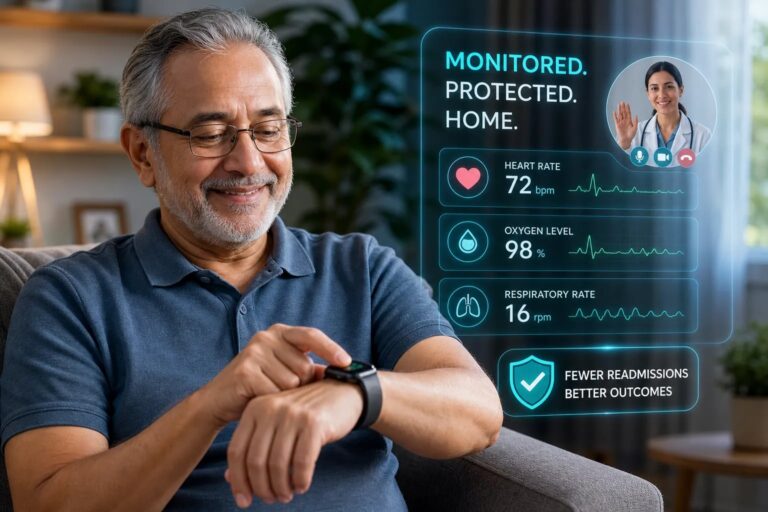
Remote health monitoring is a clinical program in which a patient uses medical-grade devices at home, those devices transmit readings to a secure platform, and a licensed care team reviews that data on an ongoing basis. It is not a fitness tracker or a wellness app. The devices used are clinically validated, the data is reviewed by trained clinical staff, and the program is ordered by a physician as part of your plan of care. In other words, this is telehealth monitoring built on continuous data, not a one-off video visit.
The clearest way to understand it is to think of it as a layer of care that exists between your appointments. Your doctor does not stop being your doctor; the monitoring fills in the space between scheduled visits with real, actionable data about how your condition is actually behaving at home.
How it differs from a standard telehealth visit
A telehealth visit is a scheduled appointment conducted over video or phone, typically reactive care where you reach out after something changes and a clinician responds. Remote health monitoring works differently. It runs continuously in the background, collecting data every day regardless of whether you have an appointment that week.
Think of it this way: a telehealth visit is a snapshot, a single frame of your health on one specific day. Continuous home-based monitoring is a running feed, giving your care team a full picture of how your condition behaves over days and weeks. Both have a place in modern care, but they serve very different purposes.
Remote patient monitoring vs. telemonitoring: clearing up the terminology
You may see different terms used across insurance paperwork, medical articles, or your provider’s communications: remote patient monitoring (RPM), telemonitoring, remote physiologic monitoring, connected health monitoring, or even telehealth monitoring. For practical purposes, they all describe the same clinical framework. A patient uses a connected device at home, and a care team receives and reviews the data.
Do not get caught up in the terminology. What matters is understanding how the program works and whether the service you are considering has licensed clinicians reviewing your data and responding when something changes, not just collecting numbers.
Why it exists: the gap between appointments
Most chronic conditions change every single day, but most patients see a physician only once every one to three months. Blood pressure fluctuates based on sleep, stress, sodium intake, and medication timing. Heart failure patients can develop dangerous fluid retention over 48 hours. COPD exacerbations often build gradually across several days before they feel severe.
The months between appointments are, for most patients, completely unmonitored. Remote physiologic monitoring fills that window by giving clinicians a continuous data stream instead of a single reading taken in a clinical setting once a quarter. That difference in visibility changes what a care team can do and how fast they can act.
How remote health monitoring works
The process is simpler than most people expect. You take a reading at home using a connected medical device, that reading transmits automatically to a secure monitoring platform, a care coordinator reviews the data, and a clinician is alerted if anything crosses a pre-set threshold. Often no portal log-ins are required on your end. In many programs, you will not need to interpret your own numbers because the care team does that for you; confirm workflow details with your provider.
Here is what that looks like in practice: a patient with heart failure steps on a connected scale each morning. The reading transmits wirelessly. A care coordinator reviews it alongside the previous two weeks of data. If the patient’s weight has increased by two or more pounds overnight, many programs flag it for clinical review because sudden weight gain can be an early sign of fluid buildup, often before symptoms like breathlessness or leg swelling appear. Specific thresholds vary by program and clinician.
From your living room to your care team: the data flow
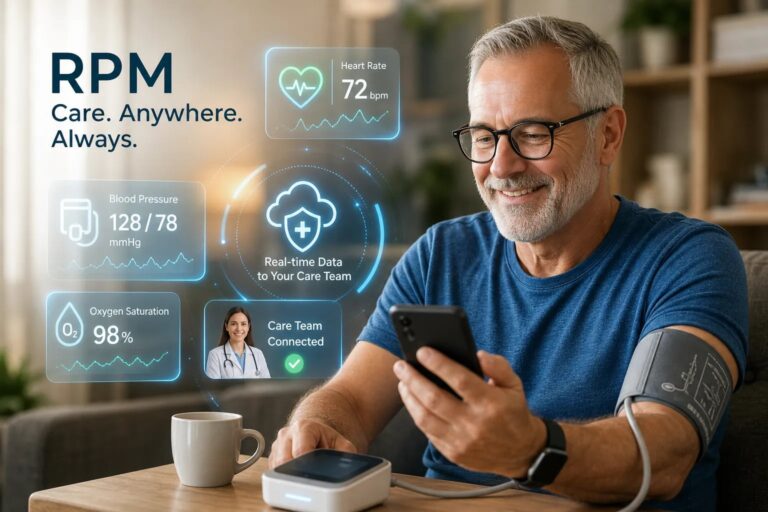
Each reading follows a straightforward path. The device captures your vital sign, transmits it via cellular connection, Bluetooth (often to a smartphone app), or Wi‑Fi to a secure monitoring platform, and the data is logged into your record alongside previous readings. The care coordinator assigned to your case reviews the trend, not just the individual number.
This trend-based review is what makes home-based clinical monitoring useful. A single blood pressure reading of 148/92 may or may not be concerning. A pattern of readings that have climbed steadily over the past ten days tells a much clearer story, and it is that story that the care team is trained to read and act on.
What triggers a clinical alert and what happens next
Before you ever take your first reading, your care team sets individualized thresholds based on your specific condition, your current medications, and your physician’s clinical judgment. If a reading crosses one of those thresholds, it does not fire an automated alarm and leave you anxious. A care coordinator reviews the reading first.
The coordinator contacts you by phone to ask about symptoms and any recent changes, such as a new medication, a shift in diet, or a stressful event. If the situation warrants clinical review, it escalates to the supervising clinician, who can adjust a medication, schedule a visit, or recommend urgent care if needed. This is a human-driven process at every step, not an automated system making decisions on your behalf.
The care team behind the scenes
A remote monitoring program typically involves several roles working together. Care coordinators review daily data, reach out when readings change, and serve as the main point of contact for patients throughout the monitoring period. Licensed clinicians, physicians and advanced practice clinicians, make treatment decisions and adjust the plan of care when readings warrant it.
Support staff handle device questions, connectivity issues, and enrollment logistics, so you have someone to call when the scale is not syncing or you are not sure whether you took the reading correctly. This team structure means you are never sending readings into a void. There are real people on the other end, trained to interpret your data in the context of your specific condition.
The chronic conditions that benefit most from monitoring at home
Remote physiologic monitoring has the strongest clinical evidence in four conditions: hypertension, heart failure, COPD, and diabetes. For each, the monitoring targets a specific vital sign that changes early in a clinical deterioration, giving the care team time to act before the situation becomes an emergency visit.
Hypertension: daily blood pressure management between visits
Blood pressure does not stay flat throughout the day. It responds to sleep, stress, exercise, salt intake, and medication timing. It is also often elevated in a clinical setting, a phenomenon called white coat hypertension, which means a single reading at a quarterly appointment may not reflect your true average pressure at home.
A validated upper-arm blood pressure cuff at home gives your care team a far more accurate picture of your actual blood pressure trends across days and weeks. Medication adjustments can be made without requiring you to come in just for a reading, which reduces unnecessary appointments and keeps your treatment more responsive to what your body is actually doing between visits.
Heart failure: why daily weight matters more than most patients realize
For patients living with heart failure, fluid retention is the primary early warning sign of a decompensation event. The problem is that fluid builds gradually; a patient may not feel noticeably short of breath until they have already gained four or five pounds of fluid weight over two or three days, by which point an intervention is both harder and more disruptive than an earlier one would have been.
A connected weight scale that highlights a rapid gain, commonly 2, 3 pounds over 24, 48 hours in many programs, can give the care team a head start to intervene with a medication adjustment or a clinical call before the situation escalates to an emergency room visit. This is a widely used application in connected home monitoring, and many programs, including RemoteHCS, incorporate daily weights for heart failure patients.
COPD: tracking oxygen saturation at home
COPD exacerbations rarely appear without warning signs. A decline in oxygen saturation typically begins days before a patient feels severe distress, and that early decline is exactly what a pulse oximeter is designed to catch. The device clips onto your fingertip and measures blood oxygen levels (SpO2) along with heart rate, transmitting readings each time you check.
Some COPD monitoring programs also add a spirometer or peak flow device to track lung function alongside SpO2, giving the care team a fuller picture of respiratory status between clinic visits. The clinical goal is early detection: catching a downward trend early enough to adjust a medication or care plan before an exacerbation requires hospitalization.
Diabetes: continuous glucose monitoring and glucometer-based RPM
Diabetes management relies on two main monitoring tools in remote programs. A standard glucometer requires a fingerstick and provides a point-in-time glucose reading. A continuous glucose monitor (CGM), such as the Dexcom G7 or FreeStyle Libre 3, is worn on the body and records interstitial glucose at frequent intervals (typically every 1, 5 minutes, device-dependent) for up to 10 days for Dexcom G7 and about 14 days for many Libre sensors, without repeated fingersticks.
CGMs identify patterns that a fingerstick reading cannot capture: overnight glucose lows, post-meal spikes, and the duration of high-glucose periods throughout the day. When this data flows to a care team through an RPM program, clinicians can adjust insulin doses, medication timing, and dietary guidance with far more precision than a quarterly HbA1c result alone allows. CGMs and other wearable health devices are increasingly part of connected health ecosystems that support ongoing monitoring.
What the clinical evidence shows about remote health monitoring outcomes
The research on connected home monitoring has grown substantially in recent years, and the findings are meaningful. Several systematic reviews and meta-analyses published between 2022 and 2025 confirm that ongoing remote monitoring improves hard clinical outcomes, particularly for patients managing heart disease, respiratory conditions, and diabetes.
Improvements in mortality, blood pressure, and hospital readmissions
A 2022 systematic review and meta-analysis of interactive remote monitoring found a 29% lower mortality risk for patients using telemonitoring versus usual care, with a risk ratio of 0.71. The same review also found meaningful improvements in blood pressure control and HbA1c levels. Separate 2024 and 2025 systematic reviews confirmed reductions in hospital admissions, readmissions, and length of stay, with improvements in glucose control and medication adherence as consistent findings across diverse patient populations.
For heart failure specifically, a 2023 meta-analysis found a lower mortality risk with remote monitoring compared to usual care, with a pooled odds ratio of 0.81, and a reduced risk of a first heart failure hospitalization with an odds ratio of 0.78. The evidence for fewer hospitalizations is particularly consistent across studies, which matters enormously for patients whose quality of life is directly tied to staying out of the hospital.
Where the evidence is strong versus still growing
Quality-of-life improvements from connected home monitoring are less consistent across studies. Some patients report feeling more engaged in their own care and more reassured between appointments. Others do not notice a significant difference in how they feel day to day, even when their clinical numbers improve. This is worth acknowledging honestly.
The strongest and most reproducible benefits are in clinical outcomes: blood pressure control, HbA1c reduction, mortality reduction, and fewer hospitalizations. These are the outcomes that most directly affect how long patients live and how often they end up in an emergency room. For anyone managing heart failure, hypertension, COPD, or diabetes, those are the numbers that matter most.
The devices used in home health monitoring programs
Medical-grade monitoring devices are not the same as consumer health gadgets. A validated upper-arm blood pressure cuff used in a clinical RPM program has been tested against ISO accuracy standards. Clinical programs typically use validated, medical-grade pulse oximeters rather than general retail models because accuracy at lower saturation levels matters significantly for COPD patients. The distinction matters because clinical decisions are made based on the data these devices produce.
Blood pressure cuffs and connected weight scales
For hypertension monitoring, validated upper-arm blood pressure monitors are the standard of care in clinical RPM programs. Wrist-based and cuffless devices are growing in popularity as consumer products, but they can differ from upper-arm cuff readings by as much as 20 mmHg and may underestimate blood pressure, particularly at higher pressure levels. For clinical decision-making, that margin of error is significant enough to affect treatment decisions.
Connected weight scales are commonly used, and often central, in heart failure management. Blood pressure cuffs and weight scales in clinical monitoring programs frequently transmit readings automatically via cellular connection; others use Bluetooth or Wi‑Fi. Taking the reading is usually the only step required from you. If connectivity is a concern, ask your provider which options they support.
Pulse oximeters and spirometers for respiratory conditions
A pulse oximeter in a clinical RPM program clips onto the fingertip and measures blood oxygen saturation and heart rate. The devices used in monitored programs are medical-grade and validated, which is important where the difference between a reading of 88% and 92% carries very different clinical meaning.
Spirometers and peak flow devices are sometimes added to COPD monitoring programs to track airflow and lung capacity alongside SpO2. Together, these tools give the care team a comprehensive picture of respiratory function between clinic visits, rather than relying on a single pulmonary function test performed once or twice a year.
Glucometers and continuous glucose monitors for diabetes
Standard glucometers provide a fingerstick blood glucose reading at a single point in time. They are straightforward to use, inexpensive, and widely covered by Medicare. CGM sensors worn on the body record interstitial glucose levels at frequent intervals, with labeled wear times that vary by device (for example, up to 10 days for Dexcom G7 and around 14 days for many FreeStyle Libre sensors). Major CGM systems such as the Dexcom G7 and FreeStyle Libre 3 are FDA-cleared and widely used in clinical remote monitoring programs.
The choice between a glucometer and a CGM depends on your condition severity, your physician’s protocol, and your clinical program’s setup. In either case, the goal is the same: getting your glucose data in front of the care team regularly enough to catch patterns and trends that quarterly lab work would miss entirely.
What Medicare covers for remote physiologic monitoring in 2026
Medicare has covered remote patient monitoring since 2018, and 2026 brought meaningful policy updates that expand access for more patients. If you have Medicare and a chronic condition managed by a physician, remote monitoring services are commonly covered under your plan.
The core billing codes and what they mean for patients
Medicare uses a set of CPT codes to reimburse RPM services. In plain terms, here is what the main codes cover:
- CPT 99453 covers the initial setup and patient education session when you first enroll. This is a one-time code billed at the start of the program.
- CPT 99454 covers the device supply and data transmission when you transmit readings on 16 or more days in a 30-day period.
- CPT 99457 covers clinical management time when your care team spends at least 20 minutes per month reviewing your data and managing your care.
- CPT 99458 is an add-on code for each additional 20-minute block of management time beyond the first 20 minutes.
Under Medicare Part B, RPM is typically subject to standard deductibles and coinsurance; coverage and cost-sharing can vary by plan (Original Medicare versus Medicare Advantage) and by which codes are billed. Confirm your coverage details with your plan before enrolling to avoid surprises.
New 2026 coverage thresholds: more patients now qualify
Two new codes took effect in 2026 that lower the previous minimums and bring more patients under covered care. CPT 99445 covers device supply and data transmission for patients who transmit readings on just 2 to 15 days in a 30-day period. Previously, you needed 16 or more days of readings to trigger any device-related reimbursement. This change means patients with variable monitoring consistency, those who travel, or those who are just getting started with monitoring can still receive covered services. Note that 99445 and 99454 are mutually exclusive: only one applies per 30-day period based on how many days you transmit.
CPT 99470 covers clinical management time starting at just 10 minutes of care team time per month, rather than the previous 20-minute minimum required for 99457. For patients with stable, well-controlled conditions who need lighter-touch monitoring, this code makes it possible to reimburse shorter management interactions rather than requiring the care team to accumulate a full 20 minutes before billing can occur.
What to ask your doctor or insurance plan before enrolling
Start by asking your physician whether remote monitoring services are available through their practice or through a partner monitoring program. Some primary care and specialty practices run their own in-house RPM workflows; others partner with external monitoring services to manage the ongoing clinical oversight and device logistics on their behalf.
If you have Medicare Advantage or a private commercial plan, ask directly whether your plan follows CMS guidelines for remote physiologic monitoring coverage. Most major payers model their RPM coverage after Medicare, but some lag on adopting the newest 2026 codes, so a direct conversation with your plan before assuming coverage is the practical move.
What to expect when you join a remote monitoring program
Joining a remote monitoring program is not a complicated process. The enrollment and onboarding experience is designed to be accessible for older adults managing chronic conditions, and the daily participation requires very little beyond taking your readings each day.
Device setup and the onboarding process
After your physician orders the RPM service, the devices are typically shipped directly to your home. A care coordinator then walks you through setup by phone or video call, verifying that the device is correctly paired and that your first readings are transmitting successfully before active monitoring begins. You do not need to be technically skilled to get through this process. The devices are designed for straightforward use, and the coordinator handles the configuration details.
Most programs verify a successful first reading before considering onboarding complete. This means your care team is not operating on an untested connection for the first several days of monitoring. If anything is not working correctly, it gets resolved during setup, not weeks later when missed readings have already created a gap in your data.
What a typical monitoring day looks like
For most patients, the daily routine is simple: take your blood pressure reading and step on the scale each morning, for example, then go about your day. The data typically transmits automatically. In many programs you will not need to log into a portal or interpret your own numbers, though some providers do use patient-facing apps; your coordinator will explain what is expected.
On most days, nothing more happens beyond the reading itself. Your data is reviewed by a care coordinator as part of their daily workflow. If everything falls within your thresholds, the monitoring continues quietly in the background. If a reading falls outside your range, a coordinator will call you, typically the same day, to check in and assess the situation.
How the care team responds when something is off
When a reading crosses a threshold, it goes to a care coordinator first, not directly to a physician. The coordinator contacts you by phone to ask about your symptoms and any recent changes in your routine, medications, or diet. This conversation matters because context changes the clinical picture: a single elevated reading after a high-sodium meal is different from a five-day upward trend with no clear explanation.
If the conversation and the data together warrant a clinical review, the coordinator escalates to the supervising clinician. The clinician may adjust a medication dose, schedule a telehealth check-in, or recommend in-person evaluation depending on the severity. Every step in this process is documented in your record, creating a clear log of what was noticed, when, and how the care team responded, which also supports Medicare billing requirements.
How to choose a remote health monitoring provider
Not all remote monitoring services operate at the same clinical level. Some platforms are primarily software companies that collect data and generate automated reports. When evaluating programs, ask for specifics: Who reviews alerts and on which days of the week? What are typical response times? Who is authorized to adjust medications? What is the documented escalation pathway for urgent issues?
What HIPAA compliance actually means for your health data
HIPAA-compliant programs are required by law to encrypt your health data, limit access to authorized personnel, maintain audit logs of who accessed your record and when, and follow the HIPAA Privacy and Security Rules that restrict uses and disclosures of protected health information (PHI). Vendors that handle PHI must also sign Business Associate Agreements (BAAs). In short, reputable programs do not permit unauthorized sale or disclosure of your PHI. When evaluating a monitoring service, ask directly whether they use HIPAA-level encryption for data in transit and at rest. In practice, that means TLS 1.2 or higher for data transmission and AES-256-class encryption for stored data as the baseline expectation.
Your health data is protected health information, and the service you choose should treat it that way at every step, from the moment your device captures a reading to the moment your care team reviews it on their monitoring dashboard. A provider that cannot describe their data security practices clearly is not one to trust with your health records.
Why condition-specific focus and licensed clinical oversight matter
A general wellness app and a clinical RPM program operate at entirely different levels of clinical accountability. A quality remote monitoring service has licensed clinicians, not algorithms alone, reviewing your data. It also has protocols tailored to your specific condition, because the alert threshold that matters in heart failure monitoring is not the same one that applies to COPD management or diabetes care.
Condition-specific clinical oversight is what separates a program that produces better health outcomes from one that simply generates a spreadsheet of numbers. Ask any program you consider: which clinicians review my data, what are their qualifications, and what is the documented escalation process when my readings are concerning?
Why RemoteHCS was built for exactly this type of care
RemoteHCS is a remote health monitoring service built for patients managing chronic conditions including hypertension, heart failure, COPD, diabetes, and kidney disease. The service operates in many states, uses HIPAA-encrypted data handling at every step, and follows Medicare and major-payer RPM guidelines. Patient cost-sharing depends on individual coverage; confirm your benefits with your plan before enrolling.
The program is designed around the clinical gap this guide has described throughout: the months between appointments where chronic conditions quietly change without clinical oversight. RemoteHCS pairs licensed clinical oversight with condition-specific monitoring protocols and connected medical-grade devices, giving patients and their families the reassurance that qualified clinicians are reviewing the data daily, not just waiting for the next scheduled office visit to find out what has changed.
Editorial note: This guide is published by RemoteHCS to provide general information about remote health monitoring. It is not a substitute for medical or insurance advice. Check with your clinician and health plan for guidance on your specific situation.
Common questions patients ask before getting started
Do I need to be tech-savvy to use the devices?
No. RPM devices are designed for older adults managing chronic conditions, not for technology enthusiasts. Many devices transmit readings automatically via cellular connection, and others use Bluetooth or Wi‑Fi. Stepping on a scale, pressing a button on a blood pressure cuff, or clipping a device to your fingertip is often the full extent of what the technology asks of you. Setup support is provided by a care coordinator during onboarding, and help is available if questions come up after that.
Will I still see my doctor in person?
Remote health monitoring supplements in-person care; it does not replace it. You will still attend your scheduled physician appointments. What changes is what your doctor knows when you arrive. Instead of a single blood pressure reading taken at the office on the day of your visit, your physician will have weeks of daily readings, weight trends, and oxygen saturation data to inform the conversation. Monitoring makes your office visits more clinically productive, not unnecessary.
How do I know if I qualify for a remote monitoring program?
Most patients with a chronic condition managed by a physician and enrolled in Medicare are eligible for remote physiologic monitoring. Your physician must order the RPM service and establish a plan of care. Patients with hypertension, heart failure, COPD, diabetes, or kidney disease are the most common candidates, though other conditions may qualify depending on the program and payer. Bring up home-based monitoring at your next appointment and ask whether your practice or a partner service offers it. That single conversation is the first step toward closing the gap.
Closing the gap between appointments
Remote health monitoring is not a futuristic concept or a niche service for early adopters. It is a practical, Medicare-covered clinical program that gives licensed clinicians real visibility into your health between appointments, a period when many changes emerge and early intervention can have the most impact.
The new 2026 CPT codes, 99445 and 99470, lower participation thresholds so more patients qualify and more types of monitoring interactions are reimbursable. If you are managing hypertension, heart failure, COPD, diabetes, kidney disease, or another chronic condition, connected care at home is within reach. Services like RemoteHCS are building this capability in communities across the United States. Bring it up with your doctor, ask about coverage, and take the first step. The gap between appointments does not have to stay empty.