What Is RPM Health Care and How Does It Work?
Chronic conditions don’t follow a schedule. Blood pressure doesn’t wait for your Tuesday appointment to spike. Blood glucose doesn’t stabilize just because your next lab draw is two weeks away. For the roughly 60% of American adults living with at least one chronic condition, a figure consistent with CDC chronic disease surveillance data, the space between clinical visits is where real health risk accumulates, often invisibly. RPM health care was built specifically to change that dynamic: it’s a clinical model in which patients use connected devices at home to transmit physiological data to a licensed care team between office visits.
RPM health care is not an app. It’s not a patient portal. It’s a structured program with enrolled patients, assigned devices, individualized alert thresholds, and clinical oversight that operates daily, not quarterly. The difference between that and a standard doctor’s appointment is the difference between a photograph and a video.
This article walks through everything that matters if you’re trying to understand RPM health care: what it actually is, how care teams use the data, who benefits most, how billing works under Medicare, what separates strong RPM vendors from data-collection tools, and what to look for if you’re evaluating a program for yourself or someone you care for.
What RPM health care actually means in clinical practice
The phrase “RPM health care” describes a specific care delivery model, not a single product, app, or device. Understanding that distinction matters because a lot of what gets marketed as remote care, including on-demand telehealth video visits, isn’t the same thing. A video call with a provider is episodic: it gives you a snapshot interaction that can be useful but is limited by the information available at that moment. RPM health care is continuous: it generates a daily stream of physiological data that gives clinicians a longitudinal view of your health between visits, not just a moment-in-time reading.
The difference between a telehealth visit and continuous monitoring
A telehealth visit replaces an in-person appointment. You connect, you talk, your provider makes decisions based on what you report and what they observe. That interaction ends, and so does the clinical visibility into your health until your next visit. RPM doesn’t replace that interaction; it fills the gap around it. Your care team sees what your blood pressure looked like every morning for the past three weeks, not just what it read when you were sitting in an exam room.
This matters enormously for chronic disease management, where the pattern over time is often more clinically meaningful than any single data point. A gradual 10-day rise in blood pressure tells a completely different clinical story than a single elevated reading at a Tuesday appointment.
How health data travels from a patient’s home to the care team
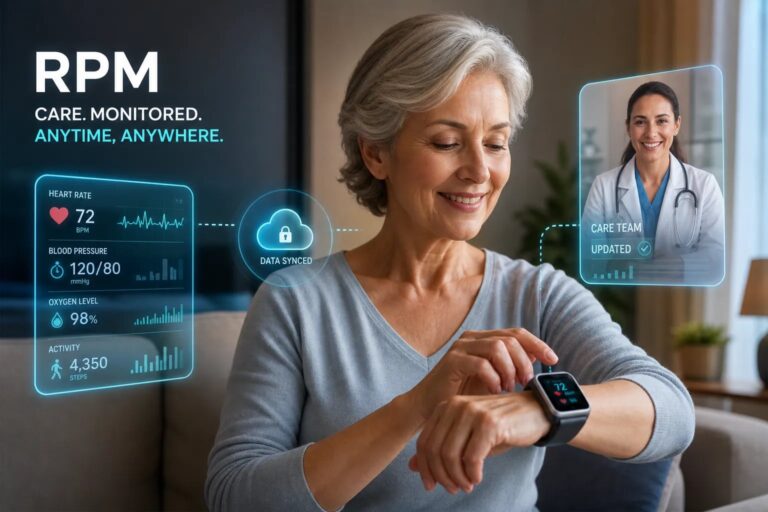
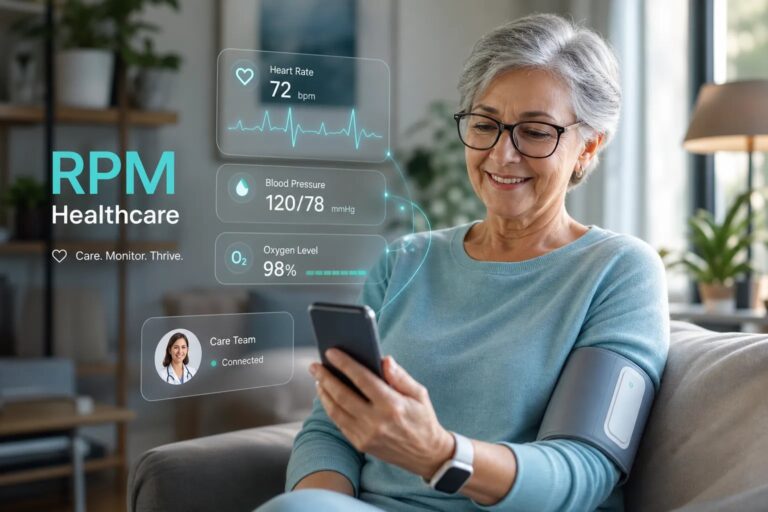
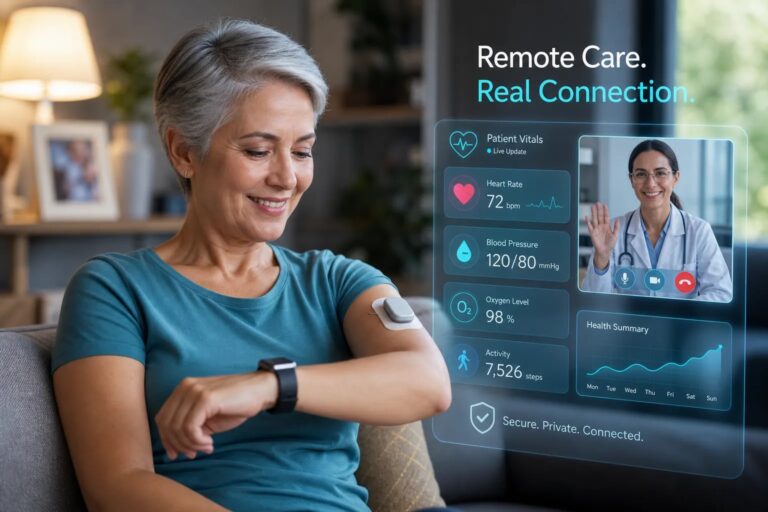
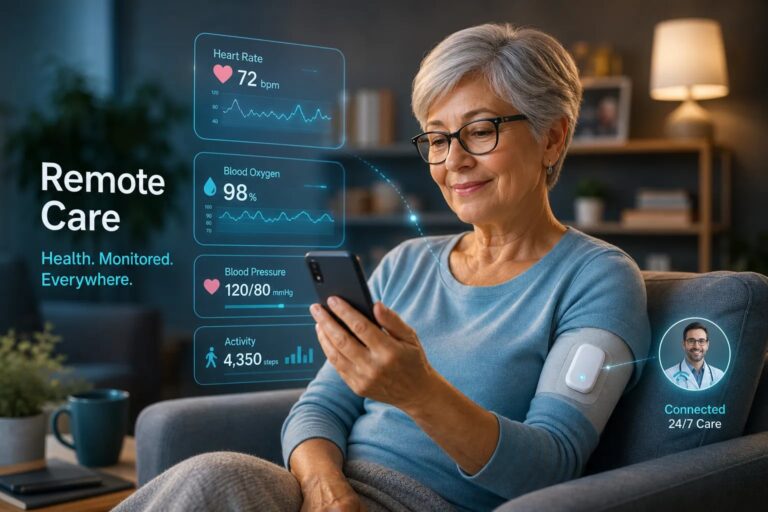
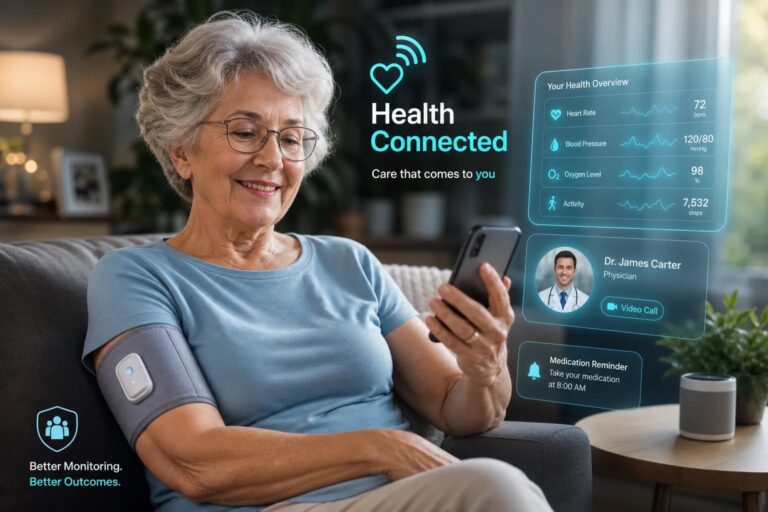
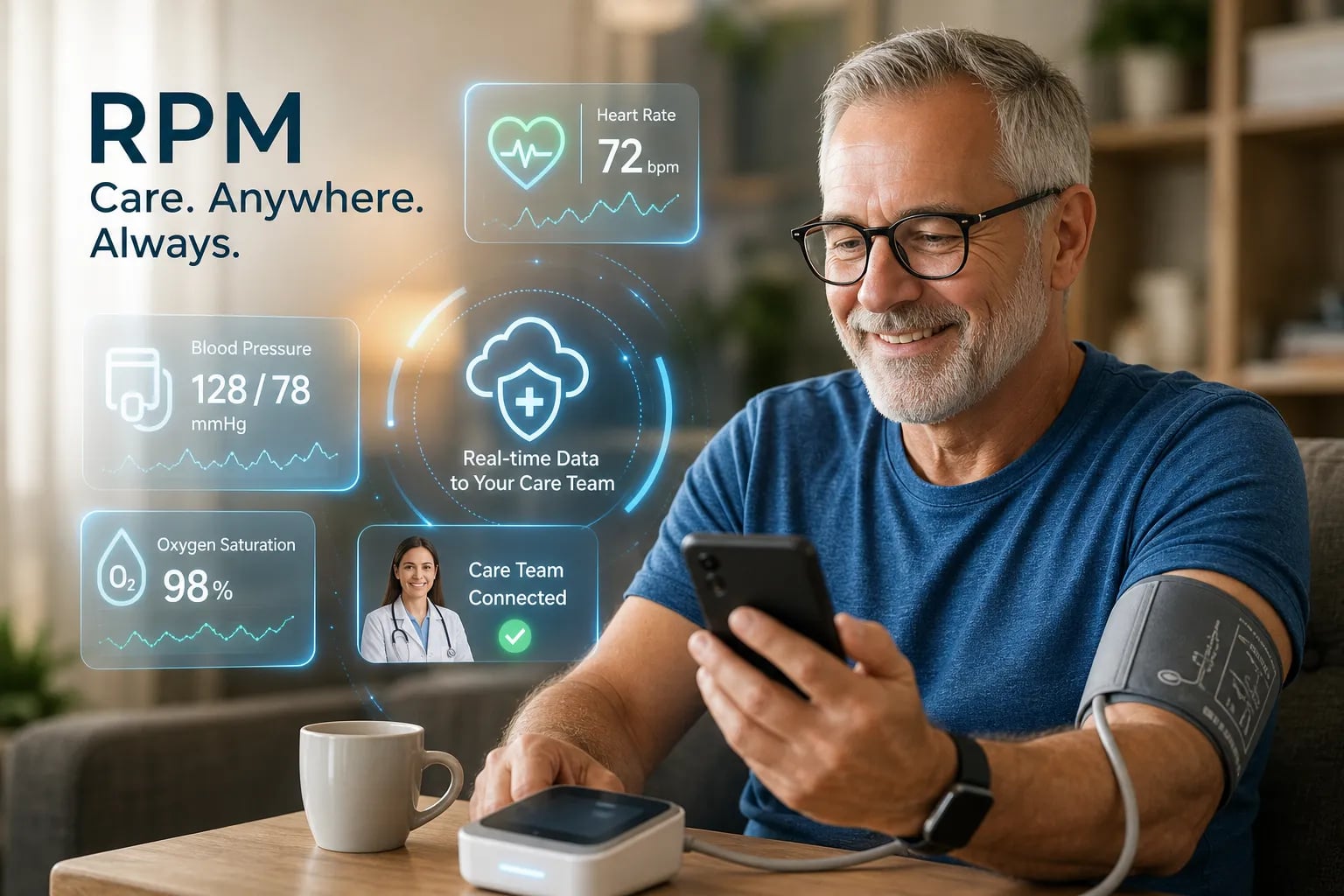
The data transmission process is straightforward. A patient takes a reading with a connected device, a blood pressure cuff, a glucometer, a pulse oximeter, a weight scale. That reading transmits automatically, either via cellular signal or Bluetooth paired to a smartphone, to a secure RPM platform. The care team accesses that data through a clinical dashboard, often integrated with the provider’s electronic health record. Alert thresholds pre-set for that patient flag any readings that require follow-up, and the care team reviews the data on a scheduled cadence while responding to alerts as they occur.
Why chronic conditions drive the majority of RPM adoption
Hypertension, diabetes, heart failure, COPD, and chronic kidney disease are the most commonly managed conditions in RPM programs, and the reason is structural. These conditions are inherently continuous: blood glucose fluctuates daily, fluid retention in heart failure can shift within 48 hours, and oxygen saturation in a COPD patient can drop over days before it becomes a crisis. Periodic office visits can’t track conditions that move this fast. RPM can, and that’s exactly why adoption for these conditions has grown steadily since Medicare formalized coverage in 2018.
The clinical gap that RPM health care was built to close
Primary care appointments are brief, typically around 18 minutes, according to time-and-motion studies of physician visit patterns, and happen every few months. For someone managing hypertension and diabetes simultaneously, that schedule creates an enormous window where dangerous changes can develop undetected. RPM health care services exist specifically to fill that window with real clinical visibility.
Why “snapshot” care falls short for chronic disease management
A blood pressure reading at a Tuesday morning appointment tells your clinician almost nothing about what happened the previous week. A patient can be dangerously hypertensive most days but present with normal readings during the appointment itself, a pattern sometimes described in clinical literature as masked hypertension. The clinician sees a normal number, makes decisions based on it, and the true pattern stays hidden. For conditions where treatment decisions hinge on accurate trend data, that’s a meaningful clinical blind spot.
What continuous monitoring makes possible that periodic visits cannot
When a care team receives daily readings, they can identify trends before those trends become emergencies. Consider the difference between these three scenarios: a gradual blood pressure increase across 10 days, a slow decline in oxygen saturation in a COPD patient, and a sudden weight gain in someone with heart failure. None of these patterns are visible without remote data. With it, a clinician can intervene, adjust a medication or schedule an urgent visit, before the patient ends up in an emergency department. The ability to act on a trend rather than react to a crisis is the clinical core of what RPM health care delivers.
How early clinical intervention changes patient outcomes
A 2021 systematic review published in JMIR mHealth and uHealth found that telemonitoring for heart failure patients was associated with meaningful reductions in hospitalization rates when combined with active clinical oversight and structured follow-up. The caveat matters: data alone doesn’t produce outcomes. It’s the combination of real-time data and clinical action that moves the needle. Programs with licensed clinicians actively reviewing readings tend to outperform software-only platforms that collect data but don’t have a trained professional on the other end making decisions with it.
How RPM health care improves chronic disease outcomes through care team workflows
A common misconception is that someone in a call center is watching a patient’s health data on a screen at all times. The actual clinical workflow is more structured than that, and more effective. Data is reviewed on a scheduled cadence. Alert thresholds are pre-set to flag readings that require immediate attention. Care coordinators and clinicians divide responsibilities based on what the data shows and what the patient’s individualized protocol requires.
How alert thresholds and escalation protocols work in practice
Each enrolled patient typically has individualized alert parameters calibrated to their condition, their baseline readings, and their clinical history. As an illustrative example, a patient with hypertension might have a protocol where systolic blood pressure above 160 triggers an outreach call from a care coordinator, while a reading above 180 routes immediately to a clinician for review. (Actual thresholds vary by program and patient and should be set according to clinical guidelines and individual history.) This tiered approach prevents alert fatigue, one of the biggest operational challenges in RPM programs, and ensures the right person responds to the right signal at the right time.
Teams also use trend-based rules alongside threshold-based alerts. A single elevated reading may stay in the review queue. The same elevated reading repeated over three consecutive days triggers a different level of response. That clinical judgment, built into the escalation protocol, is what separates reactive data logging from proactive care management.
The division of roles between care coordinators and clinicians
Care coordinators handle the daily workflow: reviewing readings, conducting scheduled check-ins, following up on medication adherence, and managing first-level outreach when a reading triggers a lower-priority alert. Physicians and nurse practitioners step in when readings cross clinical thresholds, when a patient reports new symptoms, or when the overall picture has changed enough to warrant clinical decision-making. This triage model is built around data, not as a replacement for the clinical relationship. It makes the provider’s time more precise and the patient’s care more responsive.
When data triggers action vs. when it informs routine review
Not every abnormal reading requires an urgent call. An experienced RPM care team develops clinical judgment about when to escalate and when to monitor over the next 24 to 48 hours. A blood glucose reading slightly above target in a stable diabetic patient is different from the same reading in a patient whose numbers have been rising all week. The platform surfaces the data; the clinician and coordinator interpret it in context. That contextual layer is what makes RPM health care a clinical service rather than just a data service.
Which patient populations benefit most from remote monitoring
RPM health care is a broad model, but it isn’t equally valuable for every patient. Three populations consistently see the greatest clinical and logistical benefit, and understanding who they are helps anyone evaluating RPM figure out whether it applies to their situation.
Medicare-eligible seniors managing multiple chronic conditions
Adults 65 and older with two or more chronic conditions are the core RPM population. The combination of hypertension and kidney disease, or diabetes and heart failure, creates compounding risk: a change in one condition can cascade into the other, and the monitoring requirements for both are ongoing and daily. Medicare has covered RPM since 2018, which removes cost as a barrier for most seniors. For this group, remote monitoring provides the kind of daily clinical visibility their conditions require without demanding frequent travel to a clinic.
Post-discharge patients during the highest-risk recovery window
The 30 days after hospital discharge carry the highest readmission risk of any point in a patient’s care continuum. RPM during this window gives clinicians a daily view of recovery: weight trends that might indicate fluid retention, oxygen levels that track respiratory recovery, vital sign patterns that suggest the patient is stabilizing or deteriorating. When that data is available, a care team can intervene before a preventable return trip to the hospital becomes necessary. For post-surgical and post-hospitalization patients especially, this monitoring window is a direct extension of clinical care beyond the discharge date.
Rural and mobility-limited patients with access barriers
For patients living hours from the nearest specialist, or patients whose COPD or mobility limitations make driving to a clinic exhausting and physically risky, RPM replaces the logistics of in-person care with connected clinical oversight. The care doesn’t require showing up. The data travels instead. This isn’t just a convenience feature; it’s an equity issue. Quality clinical monitoring shouldn’t be reserved for patients who live near a hospital or can navigate a parking garage. Remote monitoring extends that coverage to patients who need it most and have historically had the least access to consistent chronic care management.
The devices and platform infrastructure behind RPM services
The technology layer of RPM health care is simpler than most patients expect, and that simplicity is intentional. The best programs are designed so that a patient’s main job is to take their readings. The device handles transmission, and the platform handles the clinical workflow on the other end.
Common FDA-cleared devices used in chronic condition monitoring
The standard RPM device set for chronic conditions includes blood pressure cuffs, glucometers, pulse oximeters for oxygen saturation monitoring, digital weight scales, and spirometers for patients managing COPD or asthma. FDA clearance matters here in a way it doesn’t for consumer wellness devices. A cleared device meets clinical accuracy standards that matter when a care team is making treatment decisions based on the readings. Consumer-grade devices don’t carry the same accuracy requirements, and in a clinical monitoring context, that difference is meaningful.
Cellular vs. Bluetooth transmission and why it matters for patients
Cellular devices transmit readings automatically without requiring the patient to manage an app, pair a connection, or remember any steps beyond taking the measurement. Bluetooth devices pair with a smartphone or tablet, which introduces steps that can be barriers for elderly or low-tech patients. For the Medicare-eligible senior population that makes up the core of most RPM programs, cellular is often the right choice. It reduces friction, which directly improves how consistently patients take and transmit their readings, and consistent adherence is what makes the program clinically useful.
What a purpose-built RPM platform does beyond device data collection
A strong RPM platform is not a data warehouse. It’s a clinical operations tool. It includes configurable alert management, patient communication tools, care team dashboards, EHR integration for documentation, and billing support for CPT code compliance. The difference between a platform that collects data and one built to support clinical workflow is the difference between a program that produces outcomes and one that produces a spreadsheet nobody acts on. When evaluating any RPM platform, the right question isn’t “does it collect readings?” It’s “what happens to the readings after they’re collected?”
RPM health care billing: CPT codes, devices, and Medicare reimbursement
Medicare formalized reimbursement for remote patient monitoring in 2018 under the Centers for Medicare and Medicaid Services, and the billing model has matured considerably since then. For providers and care managers trying to understand the economics, the structure is built around four core CPT codes, each tied to a specific part of the RPM workflow.
The CPT codes that govern RPM billing for providers
CPT 99453 covers initial setup and patient education and is billed once per patient enrollment. At 2026 Medicare national non-facility rates (per the Medicare Physician Fee Schedule; actual rates vary by geography and are subject to annual update), it reimburses at approximately $21.71. CPT 99454 covers device supply and monthly data transmission; billing this code requires at least 16 days of readings collected within the calendar month, and the 2026 non-facility rate is approximately $52.11. CPT 99457 covers the first 20 minutes of monthly treatment management with interactive communication, reimbursing at approximately $51.77. CPT 99458 is an add-on for each additional 20-minute block of treatment management time, reimbursing at approximately $41.42. CPT 99091 applies when a physician or qualified health care provider directly reviews and interprets the physiologic data for at least 30 minutes in a month. Providers should verify current rates with the CMS Physician Fee Schedule lookup tool, as values differ by locality and facility status.
What providers need to meet to qualify for monthly billing
Monthly RPM billing isn’t automatic. For 99454 to be billable, the patient must transmit readings on at least 16 separate days within the calendar month. The time-based codes, 99457 and 99458, require documented interactive communication with the patient and accurate time tracking. Billing compliance is where many RPM programs lose reimbursement, not because the clinical work isn’t happening, but because the documentation of data thresholds and time logs isn’t tight enough to support the claim. A well-run RPM program treats billing compliance as part of clinical workflow, not an afterthought.
How enrolled patients are billed under Medicare coverage
Many Medicare beneficiaries have coinsurance obligations on RPM services unless covered by supplemental or secondary insurance, which often covers the remainder. For many enrolled seniors, out-of-pocket cost is minimal or zero, which is one of the most significant enrollment drivers in Medicare-aligned RPM programs. The combination of meaningful clinical benefit and low cost to the patient creates strong participation rates, which in turn drives the data consistency that makes the program clinically effective. Patients should confirm their specific cost-sharing with their plan, as obligations vary based on Medicare plan type and supplemental coverage.
What separates a strong RPM vendor from a software-only platform
The RPM market includes everything from comprehensive managed programs with licensed clinical staff to software dashboards that display device data with no human follow-through. The distinction matters enormously for patient safety and outcomes, and it’s not always obvious from a vendor’s marketing materials.
Clinical oversight vs. a dashboard with no human follow-through
Many platforms collect and display data. Fewer have licensed clinicians or care coordinators who actively review readings, respond to alerts, and contact patients when something changes. A platform without human clinical oversight isn’t RPM in any clinically meaningful sense; it’s data logging. The clinical value of remote monitoring comes from the combination of accurate data and trained humans who know what to do with it. Before enrolling in any program, ask directly: who reviews my readings, what are their credentials, and what happens when a reading triggers an alert?
HIPAA compliance and data security as non-negotiable standards
Patient health data transmitted from home devices must be protected in accordance with HIPAA requirements: that means documented technical safeguards, access controls, secure messaging for care team communication, and clear data handling policies. Best-practice programs also apply end-to-end encryption and publish their data governance policies so patients know exactly how their information is used. Be wary of any platform that is vague or evasive about how it handles patient data. The sensitivity of chronic health data, blood pressure trends, glucose levels, weight patterns, makes privacy protection a foundational requirement, not a feature.
Device logistics, patient onboarding, and ongoing support as quality signals
A strong RPM vendor manages device shipping, setup support, patient education, and troubleshooting, not just software access. For elderly patients especially, the onboarding process determines whether the program actually works in practice. If a patient can’t figure out the device or can’t get help when something goes wrong, the readings stop, the program fails, and no one benefits. Evaluate whether the vendor’s enrollment model is built to set patients up for consistent daily use, or whether it hands them a box of equipment and a PDF.
What a dedicated RPM health care company looks like in practice
There’s a meaningful difference between a general telehealth platform and a company purpose-built for chronic condition management. General telehealth is designed for on-demand acute care: a rash, a sore throat, a quick prescription refill. That model is useful for what it is, but it’s structurally mismatched to chronic disease, where the value is in what happens every day, not in episodic access to a provider.
Built specifically for chronic condition management, not general urgent care
RemoteHCS is structured around the conditions that require daily management: diabetes, hypertension, heart failure, COPD, and kidney disease. The entire service model is oriented around keeping care teams informed between visits. That specialization shows up in every layer of the program, from the device set assigned at enrollment to the alert thresholds configured for each condition to the way care coordinators are trained. A patient managing heart failure needs a different monitoring setup than a patient managing blood sugar, and a purpose-built RPM health care company structures its programs accordingly.
What condition-specific enrollment and monitoring actually looks like
At RemoteHCS, enrollment is matched to the patient’s clinical profile. A patient with diabetes is assigned a glucometer matched to their monitoring protocol. A patient managing both heart failure and hypertension receives a blood pressure cuff and a weight scale, with alert thresholds set for the specific interaction between those two conditions. Baseline data is collected after enrollment to establish what’s normal for that individual before any alerts are configured. Care coordinator check-ins are scheduled around the patient’s condition and clinical history, not a generic template. This level of specificity is what separates a program that produces clinical outcomes from one that generates a daily feed of unreviewed numbers.
Evaluating RPM health care vendors: questions that matter
Use these questions as your evaluation framework. Does the company employ licensed clinicians, not just software alerts? Are the devices FDA-cleared and matched to your specific conditions? Is billing support built into the platform so providers can bill compliantly without additional administrative burden? Is the platform genuinely HIPAA-compliant with documented and publicly available data handling policies? Is the program Medicare-aligned and available in your state? These questions separate programs that improve outcomes from programs that collect data and do nothing meaningful with it.
The gap between visits is where outcomes are actually made
RPM health care isn’t a trend or a convenience feature layered onto traditional care. It’s a clinical infrastructure built to address one of the most persistent structural problems in chronic disease management: the long, unmonitored stretch between what happens at the appointment and what happens every day at home. That gap is where blood pressure escalates, where fluid retention builds in a heart failure patient, where blood glucose trends in the wrong direction before anyone notices. RPM health care closes that gap with daily data, and licensed care teams use that data to intervene before those trends become crises.
The populations that benefit most are those who can least afford to wait: Medicare seniors managing multiple interacting conditions, post-discharge patients in their highest-risk recovery window, and rural or mobility-limited patients for whom “just come in” isn’t a realistic option. For all of them, continuous remote monitoring isn’t a supplement to good care; it is good care, delivered in a format that meets people where they actually live.
As the Medicare population grows and chronic condition prevalence continues rising, the demand for condition-specific, clinician-backed, HIPAA-compliant RPM health care will only increase. Programs built around genuine clinical oversight, proper device matching, and billing compliance will be the ones that earn patient trust and produce durable outcomes. If you’re ready to explore whether RPM health care is right for your situation or your patients, RemoteHCS is currently accepting waitlist enrollments nationwide. Visit RemoteHCS to learn more about how connected chronic care works and whether you qualify for Medicare-covered remote monitoring.