How Remote Patient Monitoring Reduces Hospital Readmissions
How does remote patient monitoring reduce hospital readmissions? It’s a question that matters both financially and clinically. Every year, hospitals across the United States pay hundreds of millions of dollars in CMS penalties because too many patients end up back in a hospital bed within 30 days of discharge. Under the Hospital Readmissions Reduction Program, CMS can cut up to 3% of a hospital’s base Medicare DRG payments for the entire fiscal year. In FY 2026, CMS estimated that more than 82% of eligible hospitals faced some form of HRRP penalty. The average penalty runs around $217,000, but for high-volume facilities, the math gets much worse.
Behind those numbers is a harder reality for patients. For someone managing heart failure, COPD, or uncontrolled diabetes, returning to the hospital within 30 days isn’t just an administrative metric. It signals a breakdown in the support structure that was supposed to keep them stable after discharge. The clinical risk of a second hospitalization compounds quickly, and the emotional toll on patients and their families is real.
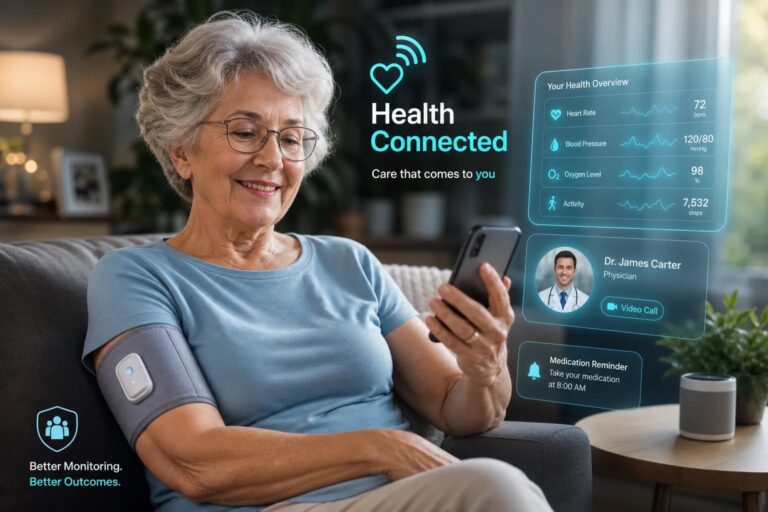
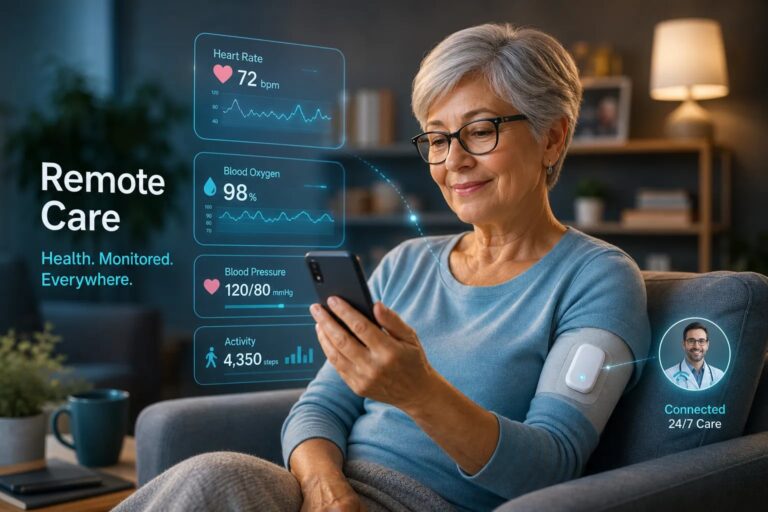
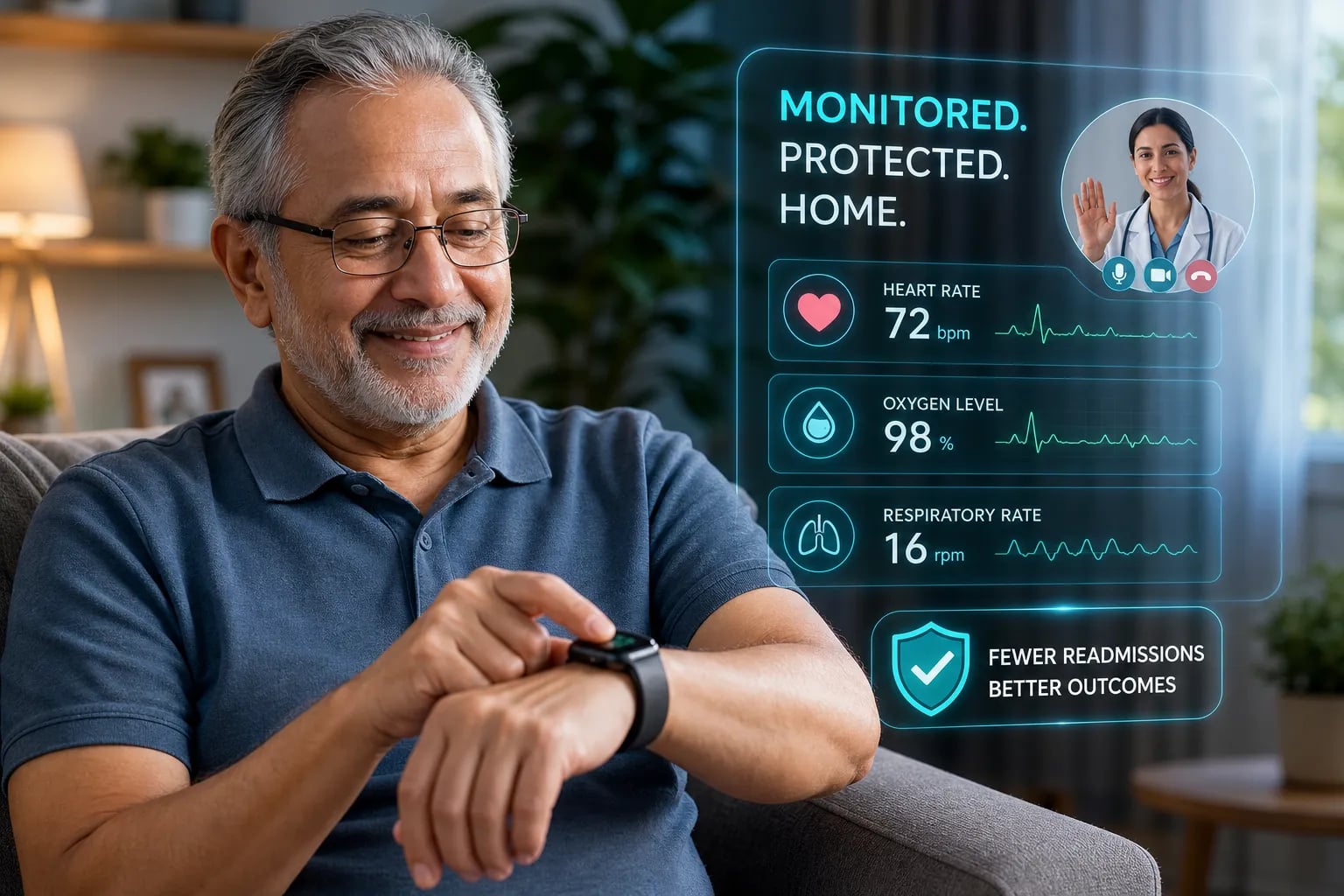
Remote patient monitoring programs were designed specifically to cover the gap between discharge and the next office visit. Services like RemoteHCS use connected devices and licensed clinicians to monitor vitals in real time, catching warning signs before they escalate into emergencies. The core question is whether the evidence actually supports that claim. This article walks through the clinical data and the mechanisms behind readmission reductions. It also covers which patients benefit most, where programs commonly fail, and the implementation framework that separates effective RPM from well-intentioned efforts that don’t move the needle.
Why hospital readmissions remain a stubborn problem
Heart failure carries a national 30-day readmission rate of roughly 23% to 25% among patients not enrolled in any home telemonitoring or remote monitoring program. That means one in four patients discharged with heart failure is back in a hospital bed within a month. For COPD and pneumonia, the numbers are similarly alarming, which is exactly why CMS built HRRP around these specific conditions. The financial consequences for hospitals are significant, but the human consequences are more urgent: each readmission represents a patient whose post-discharge care plan failed to keep up with what was happening to their body at home.
Most traditional discharge protocols were never designed to close this gap. A patient leaves the hospital with a folder of written instructions, a prescription list, and a follow-up appointment scheduled two weeks out. That’s a 14-day window where blood pressure can climb unchecked, daily weight can signal dangerous fluid accumulation, and oxygen saturation can drop without anyone on the care team noticing. Chronic conditions like heart failure and COPD decompensate through measurable physiologic signals, and passive discharge planning doesn’t capture any of them.
The problem is structural. No amount of patient education at the bedside fully compensates for the absence of ongoing clinical oversight at home. Patients feel fine one day and deteriorate quickly the next, and without a mechanism to detect that shift in real time, the first signal the care team receives is often an ED call. Remote patient monitoring was built to change that structure: continuous data, clinical alerts, and a care team that can respond before the patient reaches the point of needing emergency care.
How remote patient monitoring reduces hospital readmissions: what the clinical evidence shows
The most frequently cited RPM readmission data comes from observational studies, and the effect sizes are striking. One heart-patient study comparing RPM-enrolled versus non-enrolled patients found 30-day readmission rates of 7% versus 15%, a relative reduction of roughly 50%. At 90 days, the same study reported 12% versus 23%, a consistent directional signal. A separate program analysis found an even larger gap: 11% readmissions among enrolled patients versus 41% among non-enrolled patients, a 30 percentage-point absolute difference.
A program evaluation published in a StatPearls-indexed review reported more conservative but still meaningful numbers: 8.3% versus 11.9% at 30 days and 16.7% versus 22.5% at 90 days. These smaller effect sizes are likely closer to what well-designed programs can achieve at scale, particularly when the baseline population is not highly selected. The 30 percentage-point absolute reduction seen in the convenience-sample study is clinically plausible but warrants caution in generalization.
These are observational comparisons and program evaluations, not randomized controlled trials. Causal inference from observational data always carries limitations, including selection bias toward patients who are more engaged or have fewer barriers to technology use. That said, the directional consistency across multiple studies matters. The signal is real, consistent, and strong enough that CMS established dedicated RPM reimbursement codes in 2018. When a federal payer builds a billing infrastructure around a clinical intervention, the underlying evidence base has cleared a meaningful threshold.
Meta-analytic data on heart failure specifically reinforces this picture. A pooled analysis found a rehospitalization odds ratio of 0.78 for RPM-enrolled patients, approximately a 22% lower risk across studies. Critically, the analysis identified blood pressure monitoring as a differentiating factor: programs that included BP measurement showed significantly lower HF rehospitalization, while those without it did not produce the same effect. That’s an important design signal for anyone building a new program.
Which patients benefit most from telehealth monitoring and remote care
Heart failure is where the RPM readmission literature is strongest, both in terms of effect size and consistency. The reason is mechanistic: heart failure patients decompensate through physiologic signals that connected devices are well-suited to track. Daily weight changes reflecting fluid accumulation, blood pressure shifts, and oxygen desaturation are all measurable, threshold-able, and actionable. When an HF patient’s weight increases by three pounds in 48 hours, that’s a clinical signal, not background noise. RPM devices capture that shift before the patient feels symptomatic enough to seek care on their own.
The evidence for COPD is thinner. At least one post-hospitalization study including HF and COPD patients found nonsignificant differences in composite outcomes, suggesting that COPD patients don’t show readmission reductions as consistently or as dramatically as heart failure patients in current research. That doesn’t mean RPM is unhelpful for COPD. SpO2 tracking and symptom check-ins provide real clinical value for patients managing chronic respiratory disease. It means the readmission reduction evidence for COPD specifically is less settled, and program designers should calibrate expectations accordingly.
Patients managing two or more chronic conditions simultaneously, often called polychronic patients, represent the broadest opportunity for readmission prevention through remote monitoring. These patients carry the highest baseline risk for rapid decompensation because each condition can influence the others. Uncontrolled blood pressure worsens kidney function; fluid overload from heart failure limits respiratory capacity in a patient already managing COPD. Continuous monitoring creates visibility across all of those overlapping systems. Post-discharge patients are also a distinct high-value group. The 30-day window after any hospitalization is the period of highest clinical risk, and RPM’s ability to cover that window with daily data transmission and clinical oversight is precisely what makes it valuable for this population.
The four mechanisms that explain how RPM reduces 30-day readmission rates
Early detection of deteriorating vitals is the primary mechanism behind every reported readmission reduction. The fundamental shift RPM creates is moving clinical response upstream: instead of waiting for a patient to feel bad enough to call the doctor or go to the ER, the care team receives a data signal when vitals cross a defined threshold. Weight gain in a heart failure patient, oxygen desaturation in a COPD patient, a blood pressure spike in someone managing hypertension, all of these show up in the data before the patient is in crisis. Acting on that signal early is what prevents the readmission.
Medication adherence is the second mechanism, and it’s underappreciated. Missed or incorrectly taken medications are among the most common and preventable causes of readmission. RPM programs that include adherence tracking and clinician follow-up when patterns break create an intervention point that most standard discharge protocols simply don’t have. When a care coordinator sees that a patient hasn’t been logging readings and reaches out to find they stopped taking a diuretic because of side effects, that outreach prevents a hospitalization. The RPM data stream makes that kind of early identification possible.
Patient engagement is the third mechanism, and it’s closely tied to outcomes even though it’s harder to measure directly. Patients who take their own readings daily, receive feedback from care coordinators, and understand what their numbers mean develop self-awareness that changes their behavior. They call in sooner when something feels off. They follow up on alerts. They notice patterns. That active participation creates a layer of self-management that supplements clinical oversight and reduces the likelihood of passive deterioration going unreported.
Care coordination between discharge and the next scheduled office visit is the fourth mechanism and the one most dependent on program design. RPM creates a real-time data stream that makes it possible for a clinician to adjust a medication dose, schedule an urgent telehealth visit, or escalate a patient to a higher level of care without waiting for the next appointment. Studies that report the strongest readmission reductions consistently describe programs that pair monitoring with nurse triage, structured follow-up workflows, and cross-team communication. The data alone doesn’t prevent readmissions; the clinical response to that data does.
RPM program components linked to the best outcomes
Vital-sign threshold design is where program quality starts. Programs that define condition-specific thresholds and calibrate them to individual patient baselines consistently outperform those using generic cutoffs. For heart failure, that means daily weight monitoring, blood pressure measurement, and symptom tracking against thresholds set to that patient’s known baseline, not population averages. The meta-analytic finding that blood pressure monitoring was specifically associated with lower HF rehospitalization, while programs without it were not, makes the case for precision in device selection and threshold configuration.
Alert protocols need to be treated as clinical workflows, not just notification settings. An alert that fires without a defined response chain is a liability, not a safety net. Effective programs specify who receives each alert type, what clinical criteria trigger escalation versus routine follow-up, and what the maximum response time is for each category. Programs associated with lower readmission rates share a common feature: rapid clinician follow-up after alerts, enabling medication adjustment or early escalation before the patient’s condition worsens enough to require an ED visit.
Patient education integrated directly into the monitoring workflow distinguishes strong programs from average ones. The best-performing programs treat education as an ongoing component, not a one-time discharge event. Bi-weekly self-management assessments, condition-specific education sessions tied to what the patient’s own data shows, and progress tracking against individual goals all appear in program descriptions associated with successful readmission reductions. When patients understand what their weight or blood pressure numbers mean in the context of their condition, they engage more reliably with the monitoring process and respond faster when their own readings change.
Failure modes that can make RPM programs ineffective
Alert fatigue is the most documented failure mode in clinical decision support, and RPM programs are not immune to it. When monitoring systems generate frequent, low-value, or non-actionable alerts, clinicians adapt by responding less carefully to all of them, including the important ones. That adaptation is rational from a workload perspective and dangerous from a clinical one. The cascade is predictable: low-quality alerts lead to reduced response rates, reduced response rates lead to missed deterioration signals, and missed deterioration leads to the exact readmissions the program was designed to prevent.
False positives and low-specificity alerts create a different but related problem. When care teams spend time chasing patients who don’t need urgent intervention, higher-risk patients get less attention. Overtriage creates staff burden and eventual burnout, which erodes the program’s ability to maintain consistent response quality over time. This is especially damaging in programs serving high-volume patient panels, where clinician bandwidth is already stretched. Programs that start with poorly calibrated thresholds often see initial enthusiasm from staff followed by declining engagement as the alert burden grows.
Successful programs address alert fatigue by tightening thresholds for the specific patient population and removing duplicate or nuisance alerts. Every alert should include a clear next action: what the clinician should do, who else to loop in, and what constitutes resolution. High sensitivity alone is not the goal. Programs succeed when they balance sensitivity with positive predictive value, meaning alerts fire when they matter and don’t fire when they don’t. Achieving that balance requires continuous review of alert performance, clinician feedback loops, and willingness to adjust thresholds after deployment rather than setting them once and leaving them static.
The same discipline applies to threshold design in the initial configuration phase. Programs that skip this calibration step and deploy generic device thresholds tend to generate the highest alert volumes in the first 60 days, which is also the period when clinician buy-in is most fragile. Getting threshold design right at enrollment reduces both alert burden and early program attrition.
Implementation KPIs and what to measure from day one
Measuring the right metrics from day one is how program leaders know whether RPM is actually working or just generating activity. The core KPIs for any readmission-focused RPM program are:
- 30-day readmission rate for RPM-enrolled patients versus a matched non-enrolled group
- Alert response time, targeting under 24 hours for non-urgent alerts and faster for threshold breaches
- Device adherence rate, expressed as the percentage of days patients transmit data
- Escalation-to-intervention rate, showing how often alerts lead to documented clinical action
Tracking 90-day readmission data adds a second meaningful checkpoint and aligns with CMS outcome tracking standards.
The workflow design between alert and clinical action needs to be mapped explicitly before the program goes live. The loop should follow a defined sequence: data transmission, automated threshold comparison, alert to care coordinator, clinical triage, patient contact or escalation, and outcome documentation. Each step requires an owner, a response timeline, and a documentation standard. Programs that skip this design phase and assume the workflow will emerge organically tend to develop inconsistent response patterns and alert fatigue within the first few months.
At 90 days post-implementation, a well-functioning program should show measurable shifts in readmission rates, device compliance above 85%, and alert response rates above 90%. Programs that hit these structural targets consistently report 30-day readmission reductions in the 3-to-6 percentage-point range. At a national average readmission cost of roughly $15,200 per episode for Medicare, even a 3-point reduction across a modest patient panel represents substantial avoided cost, in addition to the clinical benefit of keeping patients out of the hospital.
Getting started with RPM to protect patients after discharge
Not all RPM platforms are built for the same purpose. On-demand telehealth apps are designed for urgent, one-off consultations. Chronic care monitoring programs, including home telemonitoring services built for post-discharge populations, are designed for something entirely different: continuous long-term management of conditions that require daily attention, not periodic attention. When evaluating RPM options for post-discharge patients or chronic disease management, the relevant question is whether the platform was designed for ongoing condition-specific monitoring or adapted from an urgent care model.
RemoteHCS was built specifically for the population most at risk for readmission: patients managing chronic conditions at home between office visits. The service includes condition-specific device tracking covering glucose, blood pressure, SpO2, weight, and renal metrics, along with HIPAA-encrypted data handling, licensed clinicians available nationwide, and a Medicare-aligned service model. The program is designed for older adults who haven’t used connected devices before, device setup is handled by the care team, not left to the patient alone, and enrollment includes a structured orientation before the first reading is taken.
For Medicare patients, RPM coverage has been in place since 2018 through CMS. CPT codes 99453 and 99454 cover initial setup and the monthly device supply and data transmission. Codes 99457 and 99458 cover clinical management time, with 99457 covering the first 20 minutes of monthly treatment management and 99458 covering each additional 20-minute block. The 99454 code requires at least 16 days of transmitted data per 30-day billing period, which is why device adherence and patient engagement are built into the program structure from enrollment. For most Medicare patients, the program is covered, devices are provided, and the goal is straightforward: fewer hospital visits, more stability at home, and a care team that knows what’s happening between appointments.
Putting this all together
The clinical evidence for how remote patient monitoring reduces hospital readmissions is consistent and directionally strong, particularly for heart failure and high-risk chronic care patients. Effect sizes range from 3-to-6 percentage-point reductions in carefully designed program evaluations to 50% relative reductions in some observational comparisons. None of these are randomized trial results, and that distinction matters for causal inference. But the consistency across studies, combined with the mechanistic logic of early detection, medication adherence support, patient engagement, and care coordination, makes a compelling case that well-designed RPM programs reduce readmissions in real clinical practice.
The caveat is in the word “well-designed.” Programs that neglect alert calibration, skip workflow design, or fail to integrate patient education don’t show the same results. Alert fatigue, false positives, and poor escalation protocols are real risks that can make an RPM program neutral or worse. The implementation framework matters as much as the technology.
The 30-day post-discharge window is the highest-risk period for patients managing chronic conditions, and remote patient monitoring is the most scalable way to provide clinical coverage during that window. For health systems, physician groups, and care management teams evaluating post-discharge strategy, exploring an RPM program built around that window is the most direct step available. RemoteHCS is currently building its patient waitlist for nationwide enrollment. The gap between discharge and the next office visit doesn’t have to go unwatched.