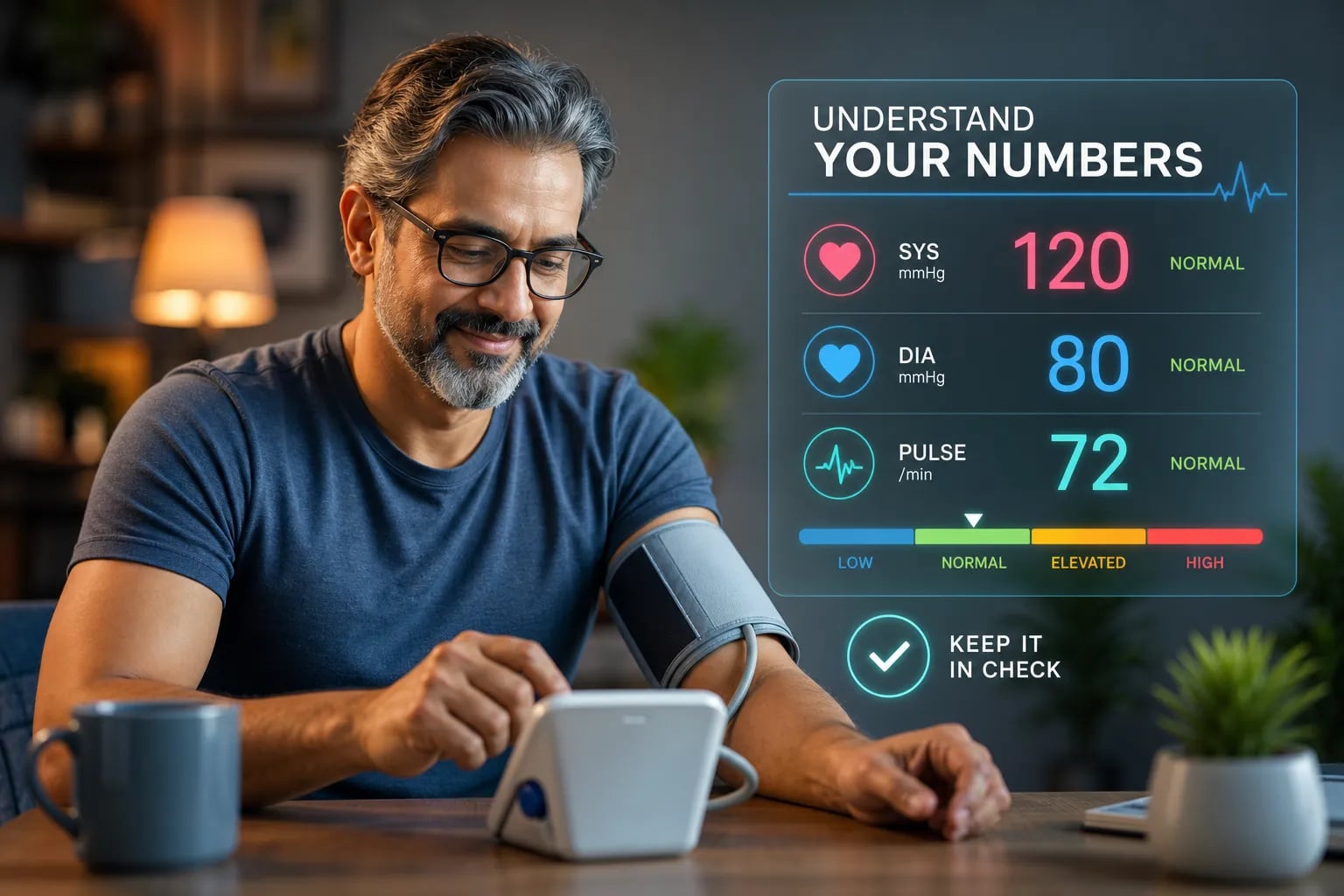
How to Read and Interpret Your Blood Pressure Numbers at Home
You’ve just pressed the button, the cuff has tightened and released, and now two numbers are staring back at you from the display. Maybe it’s 134/86. Maybe it’s 118/74. Either way, you’re not entirely sure whether to breathe easy or pick up the phone. That moment of uncertainty is where most home blood pressure monitoring breaks down. Not because the device failed, but because no one ever explained what the numbers actually mean. Understanding a blood pressure reading is the skill that turns those two digits into something you can actually act on.
Knowing how to read and interpret a blood pressure reading is one of the most practical health skills you can develop, especially if you’re managing a chronic condition like hypertension, heart failure, or diabetes. Many Americans now check their blood pressure at home every day, but checking and understanding are two different things. A log full of numbers you can’t interpret isn’t monitoring; it’s just data collection.
This article gives you the complete framework. By the end, you’ll know what each number measures, where your reading lands on the current guideline categories, how to take a measurement that’s actually accurate, and exactly when to call your doctor or head to the ER. For patients who want a licensed clinician reviewing their daily readings rather than doing it alone, services like RemoteHCS are built specifically for that, but more on that later. Those two numbers are where the explanation begins.
Understanding a Blood Pressure Reading: What the Two Numbers Mean
Your heart doesn’t push blood continuously at one constant pressure. It works in a cycle: it contracts to push blood out, then relaxes to refill. Blood pressure captures both moments in that cycle, which is why you always see two numbers separated by a slash. The top number and the bottom number each measure something distinct, and you need both to get the full picture.
Systolic pressure: what happens when your heart beats
The top number is your systolic pressure. It measures the force your blood exerts against artery walls at the moment your heart contracts and pushes blood out into circulation. In a reading of 120/80 mm Hg, the 120 is systolic. This number tends to climb with age as arteries gradually stiffen, which is why clinicians pay close attention to it even when the bottom number looks fine. In older adults, systolic pressure is generally the stronger predictor of cardiovascular risk, including stroke and heart attack.
Diastolic pressure: the number between the beats
The bottom number is your diastolic pressure. It measures the pressure in your arteries during the brief moment between heartbeats when the heart relaxes and refills with blood. In that same 120/80 example, the 80 is diastolic. Diastolic pressure isn’t the same as resting heart rate. Your blood vessels still carry active pressure between beats; it’s simply lower than during contraction. Think of it as the baseline tension your arteries hold even when the heart isn’t actively squeezing.
Why both numbers matter together
Neither number tells the full story on its own. A high systolic with a normal diastolic still carries cardiovascular risk. A normal systolic with an elevated diastolic also warrants clinical attention. Both numbers together reveal how hard your cardiovascular system is working across the full heartbeat cycle. The unit of measurement you’ll see on every monitor and guideline chart is mm Hg, which stands for millimeters of mercury. It’s the standard unit used to quantify pressure in the circulatory system, inherited from older mercury manometers that have long since been replaced by digital devices.
The blood pressure chart: categories from normal to hypertension
Once you know what the numbers measure, the next step is knowing where your reading falls. The ACC/AHA 2017 classification framework remains the current standard in U.S. clinical practice as of 2026. It breaks adult blood pressure into four categories, and understanding each one helps you respond proportionately rather than either dismissing elevated readings or catastrophizing normal fluctuations.
Normal and elevated: the ranges most people misunderstand
Normal blood pressure is below 120/80 mm Hg. Below that threshold, your cardiovascular risk from blood pressure alone is low, and no clinical intervention is typically needed. The “elevated” category covers systolic readings between 120 and 129 with a diastolic still below 80. This is not yet hypertension, but it’s not nothing either. Many people in this range assume they’re fine because they haven’t crossed the 130 line, but elevated blood pressure is a signal that lifestyle changes, diet, activity, stress management, weight, should start now before the numbers climb further.
Stage 1 and Stage 2 hypertension: where treatment decisions shift
Stage 1 hypertension covers a systolic of 130 to 139 or a diastolic of 80 to 89. Stage 2 hypertension applies when systolic is at or above 140, or diastolic is at or above 90. Notice the “or” in those definitions: either number being in the range is enough to place you in that category. Both stages typically trigger clinical follow-up, lifestyle intervention, and sometimes medication depending on your overall cardiovascular risk profile. One thing worth knowing: the ACC/AHA lowered the hypertension threshold to 130/80 back in 2017, down from the older 140/90 standard. If you were told years ago that your blood pressure was fine, it’s worth revisiting those numbers against the current framework, because some people who were considered normal under the old cutoff are now classified as Stage 1.
A note on hypertensive crisis and international guidelines
At the top of the chart sits hypertensive crisis, defined as a reading at or above 180/120 mm Hg. This threshold gets its own dedicated section later because it requires specific action steps, but it belongs on the chart so you have the full picture. It’s also worth noting that the World Health Organization uses 140/90 as its primary operational threshold for defining hypertension globally. If you’ve seen different numbers referenced by an international physician or in older materials, that’s the likely source of the discrepancy.
Understanding a Blood Pressure Reading at Home: How to Take an Accurate Measurement
An accurate blood pressure reading starts before you ever touch the device. The measurement itself takes less than a minute, but the preparation, positioning, and follow-through are what determine whether the number reflects your actual blood pressure or a collection of errors stacked on top of each other. Technique errors are among the most common causes of transiently high home readings.
Getting your body and environment ready
Give yourself a 30-minute prep window before measuring. That means no caffeine, no exercise, no smoking, and no alcohol in the 30 minutes prior. Empty your bladder first, since a full bladder can push readings higher. Then sit quietly for five full minutes before pressing start. That five-minute rest is not optional; it’s the step most people skip and the one that most consistently inflates home readings. Rushing from the kitchen to the chair and immediately starting the measurement will give you a number that reflects your activity, not your baseline blood pressure.
Positioning the cuff and your body correctly
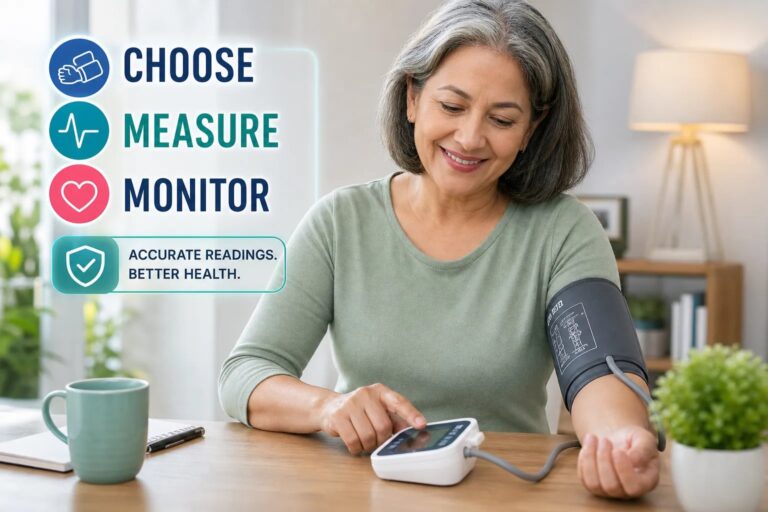
The cuff goes on your bare upper arm, not over a sleeve or clothing. Position the bottom edge of the cuff just above the bend of your elbow, snug enough that you can slip two fingers underneath, but not so tight that it pinches. Your arm should rest on a flat surface, like a table, with the cuff at roughly the same height as your heart. Sit with your back supported, feet flat on the floor, legs uncrossed. Upper-arm monitors are the recommended standard for home use; wrist monitors are less accurate for most people because the reading is highly sensitive to wrist angle and position relative to heart level.
Taking, repeating, and recording your readings
Take two readings about one minute apart and average them. A single measurement is too vulnerable to random variation, whether from a momentary stress spike, a residual cuff artifact, or an irregular heartbeat. Two readings give you a more stable estimate of your actual pressure at that moment. Record both readings along with the date, time, and which arm you used. Consistency matters: use the same arm every session. If this is your first time measuring at home, check both arms on the initial session to see whether one consistently reads higher. If there’s a meaningful difference, use the higher arm going forward and flag it for your clinician.
Why your blood pressure numbers change throughout the day
Blood pressure is not a fixed number. It shifts constantly in response to what your body is doing, what you’ve eaten, how you’re feeling, and even what time of day it is. Understanding this variability keeps you from panicking over a single high reading and from dismissing a real pattern because one morning measurement looked normal.
Natural daily patterns and what drives them
Blood pressure follows a circadian rhythm. It’s typically at its lowest during sleep, then rises sharply in the early morning hours as the body prepares to wake, a pattern called the “morning surge.” From there, it fluctuates throughout the day based on physical activity, meals, hydration, emotional state, and posture. A reading taken right after waking up will look meaningfully different from one taken mid-afternoon, and both can be completely normal for the same person. This is normal physiology, not a sign that your monitor is broken or your medication has stopped working.
Factors that temporarily push numbers up
Several specific variables inflate a reading above your true baseline. Recent physical activity is a major one; blood pressure rises during exercise and takes time to return to resting levels. A large meal, alcohol, cold weather, emotional stress, acute pain, and even a full bladder all push numbers higher temporarily. This is exactly why the prep routine from the previous section matters so much. When you control those variables consistently before each measurement, your readings become comparable across days and weeks. Without that consistency, you’re comparing apples to oranges every time you look at your log.
Common measurement errors that distort your results
Beyond daily variability, there are specific technique errors that produce readings that don’t reflect your actual blood pressure. These are systematic problems, meaning they’ll skew your results the same way every time you repeat the mistake, which makes them harder to spot on your own.
Cuff fit and monitor placement errors
Cuff size is the most commonly overlooked source of error in home monitoring. A cuff that’s too small will produce readings that run artificially high; one that’s too large may read low. The cuff bladder should encircle roughly 80% of your upper arm. Most monitors come with standard adult cuffs, but if your arm circumference is larger than average, you need a large adult cuff specifically. Arm position matters equally: if your arm is hanging at your side rather than resting on a flat surface at heart level, the reading will be off because gravity changes the hydrostatic pressure in the blood vessels.
Behavioral and situational errors
Talking during the measurement, crossing your legs, slouching without back support, measuring immediately after walking in from outside, or checking your blood pressure in the middle of a stressful phone call all skew your results. Taking a single reading and treating it as definitive is another common mistake. One number on one day is almost never meaningful in isolation; it’s the pattern across multiple correct measurements that tells your clinician something useful. Two readings per session, taken consistently, give you the kind of data that actually supports good medical decisions.
White-coat hypertension and masked hypertension: two patterns worth knowing
Not everyone’s clinic reading matches their home reading, and the divergence isn’t always random. Two well-documented clinical patterns explain why office and home blood pressure can tell genuinely different stories, and understanding them helps you have a more productive conversation with your care team.
White-coat hypertension: when the clinic itself raises your BP
White-coat hypertension describes a pattern where blood pressure reads high in a clinical setting but falls to normal at home. It affects roughly 20 to 40 percent of people diagnosed with hypertension, which makes it far more common than most patients realize. The mechanism is an alerting response: the clinical environment triggers mild anxiety or arousal, activating the sympathetic nervous system and transiently raising blood pressure. This isn’t simply being nervous about the appointment; it’s a real autonomic response that elevates readings even in people who feel completely calm. Because white-coat hypertension can lead to unnecessary medication or treatment escalation, U.S. guidelines recommend confirming elevated office readings with out-of-office measurements before initiating therapy.
Masked hypertension: the harder pattern to catch
Masked hypertension is the reverse: normal office readings, but elevated blood pressure at home or during daily activity. It’s more dangerous from a monitoring standpoint because it’s invisible to clinic-only checks. A person with masked hypertension walks out of every appointment with a clean bill of health while carrying sustained elevated pressure during their actual daily life. According to evidence cited in the 2017 ACC/AHA hypertension guidelines, masked hypertension is associated with roughly a twofold increase in cardiovascular events compared to people with consistently normal readings, a risk profile close to that of sustained hypertension. Consistent home blood pressure monitoring is the primary way to identify masked hypertension, since ambulatory blood pressure monitoring over 24 hours is the other main detection tool but isn’t always accessible or practical for routine screening.
When your numbers mean it’s time to call a doctor or go to the ER
Knowing what to do with a number is the practical payoff of everything covered so far. The action framework is straightforward, and you should know it clearly before you’re ever in a situation where you need to apply it quickly.
The 180/120 threshold and what to do right now
A reading at or above 180/120 mm Hg is a hypertensive crisis. If that reading comes with any of the following symptoms, call 911 immediately: chest pain, shortness of breath, severe headache, sudden vision changes, confusion, difficulty speaking, weakness or numbness on one side of the body, or severe back pain. These symptoms alongside a critical blood pressure reading indicate possible organ damage and cannot wait for a clinic appointment or a callback. If your reading is at or above 180/120 but you have none of those symptoms, rest quietly, wait a few minutes, and repeat the measurement. If it stays at that level, contact a clinician right away rather than waiting to see what happens over the next few hours.
What to do with consistently elevated readings below the crisis level
A single high reading below the crisis threshold is not a diagnosis. One elevated number on one day can reflect a preparation mistake, a stressful hour, too much coffee, or just normal variability. What matters is the pattern across multiple correctly taken measurements over days or weeks. If your readings consistently land in the Stage 1 range (130 to 139 systolic or 80 to 89 diastolic), schedule an appointment to discuss lifestyle modifications and have your overall cardiovascular risk assessed. If you’re consistently seeing Stage 2 readings (140 or higher systolic, or 90 or higher diastolic), that warrants timely evaluation. Don’t wait for your next scheduled quarterly visit; call and let your provider know what you’re seeing at home.
Symptoms that change everything, regardless of the number
Certain symptoms always warrant urgent evaluation, no matter what the blood pressure display reads. Sudden severe headache, vision disturbances, chest tightness, confusion, or one-sided weakness are warning signs of a potential stroke or hypertensive emergency. If any of those symptoms appear alongside any elevated reading, don’t pause to repeat the measurement or wait to see if the feeling passes. Go to emergency care immediately. These symptoms combined with high blood pressure define a true hypertensive emergency, and the response time matters.
Moving from taking readings to having a clinician review them
Measuring your blood pressure consistently at home is genuinely valuable. But measurement is only half the equation. The other half is what happens with those numbers afterward, and this is where most self-monitoring programs fall apart. Readings that sit unreviewed in a device app are, in practice, no different from readings that were never taken.
Why a log of readings is more valuable than any single number
A two-week log of morning readings, taken at the same time each day with the same arm, gives your clinician real diagnostic material. It reveals patterns: whether your pressure spikes on weekdays but normalizes on weekends, whether it’s trending upward over time, whether a recent medication adjustment is working. A single reading taken at the office, by contrast, is a snapshot from a moment that may reflect white-coat effect, the coffee in the parking lot, or a stressful commute. Trends measured at home are generally more informative than individual office readings, and clinicians who have access to home logs consistently make better-informed decisions about medication dosing and lifestyle recommendations.
The clinical gap between appointments
Many patients with hypertension see their physician every three to six months, depending on how well their condition is controlled and what other health factors are in play. A lot changes in that window: medication adjustments take effect, diet shifts, stress events accumulate, new symptoms emerge. Without a system for regularly reviewing home readings between those appointments, the clinician is working from incomplete information at every visit. The patient, meanwhile, is left interpreting numbers they may not fully understand and deciding on their own whether something warrants a call. That gap is where preventable complications often develop undetected.
How licensed clinical review closes the loop
This is the problem that remote patient monitoring is specifically designed to solve. RemoteHCS enrolls patients in an ongoing monitoring program where licensed clinicians review daily blood pressure readings, identify patterns that fall outside safe parameters, and follow up directly with patients when numbers trend in the wrong direction. For someone managing hypertension alongside heart failure or kidney disease, that kind of continuous clinical oversight means a dangerous pattern gets caught in days rather than discovered months later at a quarterly check-in. If you’re currently managing a chronic condition and measuring your blood pressure at home without anyone reviewing those numbers between appointments, it’s worth asking your care team whether remote monitoring is an option for you.
Putting it all together
Understanding a blood pressure reading is a two-part skill. The first part is knowing what the numbers actually represent: the top number (systolic) measures pressure during a heartbeat, the bottom number (diastolic) measures pressure between beats, and together they place your cardiovascular health into one of four categories. Normal is below 120/80. Elevated is 120 to 129 systolic with a diastolic below 80. Stage 1 hypertension begins at 130/80, Stage 2 at 140/90, and anything at or above 180/120 is a crisis requiring immediate action.
The second part is taking measurements that actually reflect your real blood pressure: preparing for 30 minutes, resting for five, positioning correctly, using a validated upper-arm cuff, and taking two readings per session rather than one. Those steps aren’t bureaucratic fussiness; they’re what separates useful data from noise. A log of accurately taken readings tells a clinical story. A log of rushed, poorly positioned readings tells a story too, just not a reliable one.
Consistent home monitoring is more informative than any single office check. But what you do with those readings afterward is what actually protects your health. Share your home log with your care team at every appointment, and if you’re managing hypertension or another chronic condition, ask whether a remote monitoring program could keep a clinician in the loop between visits. Understanding a blood pressure reading is the starting point. Having someone who knows what to do with it is the part that matters.